By Jack Nash
03 September 2019
In this blog, Molly Cranston; Senior Associate Editor at F1000 and Jonathan Threlfall; Editorial Data Lead and Senior Assistant Editor at F1000, discuss the policies and guidelines implemented by Wellcome Open Research to ensure our adherence to the core practices of COPE.
Article collections on Wellcome Open Research are designed to serve the community in a way that works for them and there are many ways in which one can utilise this functionality. Demitra Ellina, Editorial Community Manager, F1000, tells us more.
By Guest Author
15 June 2018
Charli Colegate, Portfolio Developer in the Humanities & Social Science research funding department at Wellcome talks about how Wellcome Open Research can help researchers overcome some of the issues associated with publishing social science and humanities research.
By Guest Author
20 February 2018
Mesh is an open-access web space for people involved in community engagement with health research in low and middle-income countries (LMICs). Mesh provides a neutral location for engagement practitioners, researchers, health workers and others to find resources, seek expertise, and share their questions and experiences. Users of Mesh have access to a wide variety of […]
By Jack Nash
20 July 2017
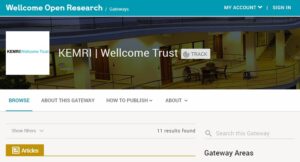
We’ve added a new functionality on Wellcome Open Research. Gateways offer Wellcome-funded researchers and communities the opportunity to create their own branded “publishing home” for their research outputs designed to suit their needs. The first Gateway to be launched on the platform is for one of the Africa programmes, the KEMRI-Wellcome Trust Research Programme (KWTRP), Kenya.
By Guest Author
10 April 2017
Researchers Irene Omedo and Philip Bejon explain how targeted malaria control could benefit the surrounding community and discuss the benefit of post publication peer review.
By Guest Author
10 February 2017
Marta Teperek describes a new pilot project being undertaken at the University of Cambridge with the aim of finding out what can be done to bring about more open research practices.
By Guest Author
30 January 2017
Scientific publications are the main medium for sharing scientific results and assertions supported by observational data. Consequently, bioinformatics resources depend on research literature to keep the content updated; a task carried out by curators, who extract information from articles and transfer its essence to the corresponding resources. Therefore, services that support researchers and curators in browsing the content and identifying key biological concepts with minimal effort would be beneficial for the community.