Theatres of surgery
| 2 October, 2018 | Suzannah Biernoff |

A Q&A with Suzannah Biernoff about her research on the cultural pre-history of face transplants.
This is a fascinating piece of research, why did you explore the cultural pre-history of face transplants?
A lot of my research over the past decade has dealt with the aesthetics and cultural meanings of disfigurement, including responses to facial injury and surgical or prosthetic ‘repair’.
This started out as a project with specific historical and geographical parameters, focusing on First World War Britain and the cultural impact of facial war injuries, but as time went on I found myself pursuing tendrils of interest into the more distant past as well as into the present.
A chapter of my recent book Portraits of Violence: War and the Aesthetics of Disfigurement looks at the use of historical medical photographs of plastic surgery patients as inspiration for the computer game BioShock, and research on First World War portrait masks piqued my interest in the long history of cast portraits, both living and dead.
While I was researching this material, I started following the story of Isabelle Dinoire, who became the world’s first face transplant recipient in 2005 and died, aged 49, in 2016. Her experience, and the ethical debate surrounding it, made me realise that facial transplantation is not simply a new surgical innovation, but an idea with a complex and fascinating history.
What did you learn about the relationship between the medical progress and the cultural representation of face transplants?
A form of composite-tissue allograft, facial transplantation involves the transfer of skin, nerves, blood vessels, muscles and sometimes bone from a brain-dead donor to a live recipient. The donor tissue is literally ‘incorporated’ into the recipient’s body if the transplant succeeds (although the risk of chronic or acute rejection is ever-present). It is, in other words, an extraordinarily challenging undertaking, for the recipient and their family as well as the medical teams involved.
Journalistic accounts tend to dwell on these medical details, and often include clinical photographs as well as family snapshots and editorial images as illustrations (Getty Images, for example, has several pages devoted to Isabelle Dinoire).
In her landmark study of attitudes towards cadaveric organ donation in contemporary America, Strange Harvest, Lesley Sharp identifies a persistent paradox. Donors are, on the one hand, routinely depersonalised by medical professionals (and must be declared legally dead). Yet the donor is often perceived to live on in the recipient.
The intense media interest in Dinore’s operation resulted in a style of reporting that was almost pathologically personal. Controversially, the identity of the donor was revealed in the press, along with a photograph that has been widely reproduced. Dinoire, whose injury occurred during a suicide attempt, found out from journalists that the donor had committed suicide and subsequently referred to her as ‘my twin sister’. So while the medical literature tends to present the human face and its constituent elements as ‘spare parts’, this is not borne out by media representations.
How has face transplantation mainly been represented?
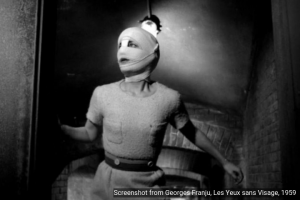
In my article I wanted to think about the longer cultural history of the transplanted face, its presence in literature, legend and visual culture before it became a medical possibility at the beginning of the 21st century. I’d read histories of plastic surgery, which often begin with the sixteenth-century surgeon and nose-crafter Gaspare Tagliacozzi (1545-99), but I was less familiar with the history of organ transplantation. The article I ended up writing focuses on the first cinematic face transplant, in Georges Franju’s Les Yeux sans Visage (Eyes Without a Face, 1959).
Coinciding with the first successful organ transplants of the 1950s and 60s, Eyes Without a Face is often described as a modern re-telling of Mary Shelley’s Frankenstein – a dark and cautionary tale of scientific hubris and its unintended consequences. Plastic surgery and disfigurement had already been established as tropes of horror cinema by the 1950s, as had brain and hand transplants (most memorably in Karl Freund’s 1935 film Mad Love). But Franju’s film isn’t just horrific, it is also very stylish, with its surrealist aesthetic and exquisite costumes, including the immaculate white mask that replaces Christiane’s absent face. These varied and often ambiguous cultural representations are, I suggest, part of the ‘pre-history’ of the face transplant and have played a crucial role in shaping public attitudes.
Why did you decide to publish on Wellcome Open Research?
Academic journals often serve to entrench and police disciplinary boundaries, limiting the possibilities for cross-disciplinary dialogue. As a Wellcome Trust-funded researcher, I was drawn to WOR because it bridges a particularly stubborn divide, between the medical humanities and the biomedical sciences, while also making new research freely accessible to everyone.