Wellcome Open Research: first year in numbers
| 16 November, 2017 | Abbie nicholson |
Michael Markie, Publisher at F1000, and Robert Kiley, Head of Open Research, Wellcome, highlight Wellcome Open Research’s many achievements in its first year of publishing.
Wow, it’s been a whole year since Wellcome Open Research was launched as the world’s first funder-based publishing platform.
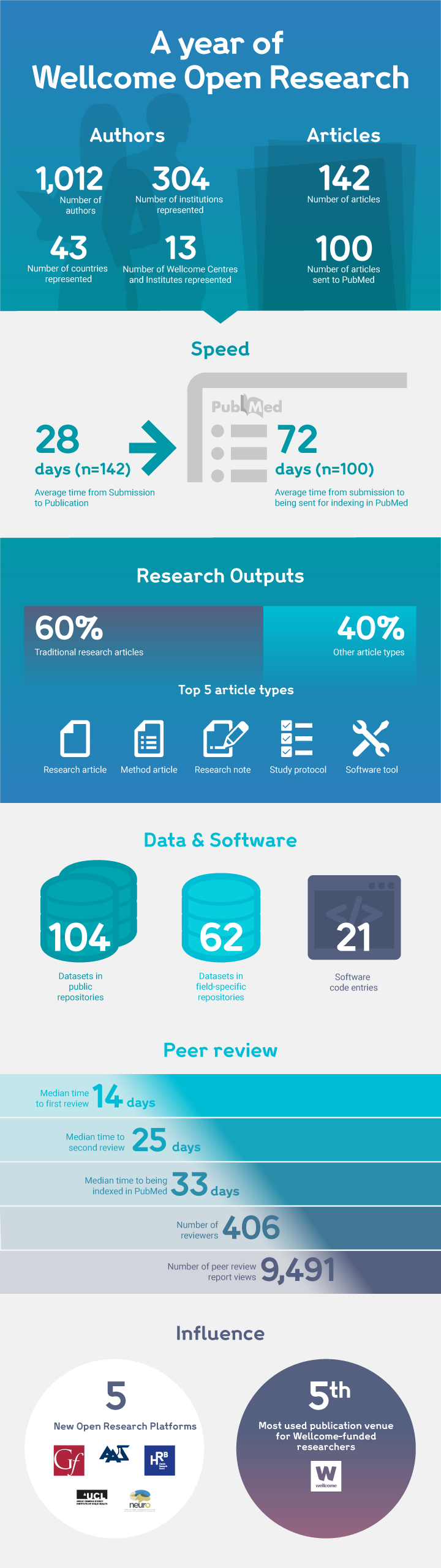
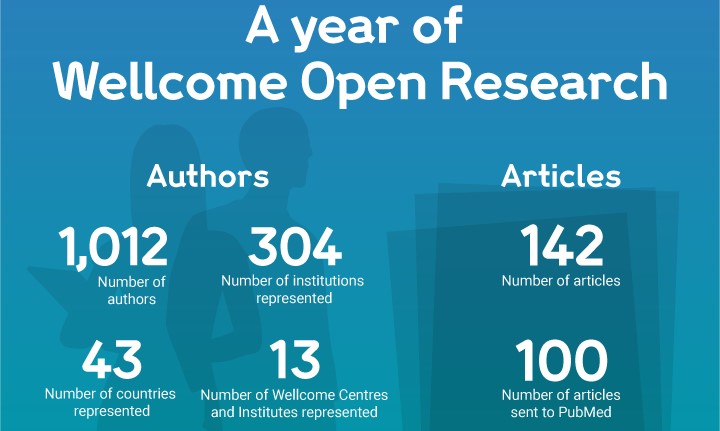
In this time a number of milestones have been reached including hitting the 100 articles published mark in August (a total which now stands at 142) and the fact that by volume of publications indexed in PubMed, the platform is the fifth most used publication venue for Wellcome-funded researchers.
One major benefit of this model of publication is the lower costs compared to other publishing venues. You can find more information on article processing charges on Wellcome Open Research here.
More broadly, Wellcome Open Research has helped to encourage other funders, organisations and institutions to launch their own publishing platforms. Just last week, the Bill & Melinda Gates Foundation published its first few articles on the Gates Open Research platform and only yesterday the African Academy of Sciences (AAS) announced they will be following suit with their own platform. Similar announcements have been made by the Irish Health Research Board, the Montreal Neurological Institute and UCL Great Ormond Street Institute of Child Heath. Over the coming months we expect other funders and institutions to make similar announcements.
To celebrate this successful first year, we have created an infographic highlighting some of the key numbers that represent our achievements to-date (also available as a PDF here). Onwards and upwards for the next year!
Update (27th November 2017): It has come to our attention that we made an error in calculating the average time from submission to publication, and the average time from submission to being sent to PubMed.
The correct data is as follows:
a) Average time from submission to publication – based on 142 publications – is 28 days (not 23.5 as we reported previously)
b) Average time from submission to when content has passed peer review and is sent to PubMed – based on 100 submissions – is 72 days (not 45 days as we reported previously).
We would like to apologise for these errors. The full dataset that supports the (updated) graphic below is available here.