A research collaboration rules out a clonally transmissible cancer epidemic in California sea lions
| 6 October, 2017 | Máire Ní Leathlobhair & Elizabeth Murchison |
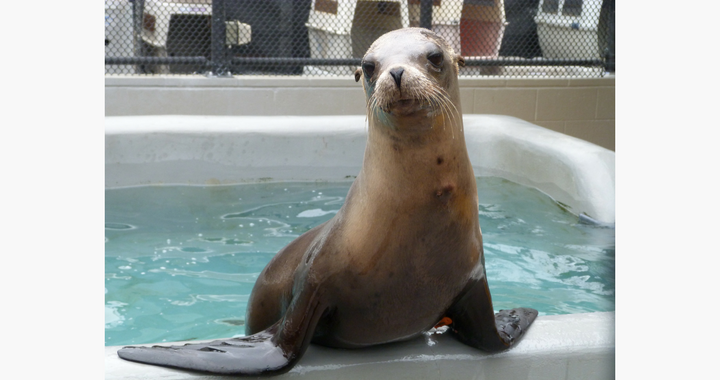
Arlen, a California sea lion treated at the Marine Mammal Center and photographed by Adam Ratner. Image credit: © The Marine Mammal Center
Elizabeth Murchison and Máire Ní Leathlobhair, Department of Veterinary Medicine, University of Cambridge, discuss the research taking place at the Marine Mammal Center and studying a highly prevalent cancer in California sea lions.
The Marine Mammal Center is one of the largest marine mammal rehabilitation hospitals in the world. Nestled in the hills of the Marin headlands, just outside of San Francisco, the facility is perfectly situated near a hubbub of marine biodiversity. Astonishingly, since 1975 the Center has treated more than 20,000 patients, mostly different species of cetaceans and pinnipeds.
“Staff scientists at the Center are grappling with the question of what exactly is causing this unprecedented cancer epidemic, with a cancer-causing virus being the most likely culprit.”
The research conducted by the Marine Mammal Center is largely focused on advancing marine species conservation and rehabilitation efforts. One topic of particular importance to the scientists there is a highly prevalent cancer in California sea lions. Since 1979, hundreds of stranded California sea lions have been admitted with disseminated carcinoma. The Center houses detailed records of every sea lion admitted, tracking the discovery, progression and epidemiology of this mysterious disease over the past 38 years.
Urogenital carcinoma (UGC) is an aggressive and widely metastatic cancer arising in the urogenital epithelium of California sea lions. Typically, 20-25% of adult California sea lions seen at the Center are afflicted with this cancer, and most of these individuals are later euthanized. Staff scientists at the Center are grappling with the question of what exactly is causing this unprecedented cancer epidemic, with a cancer-causing virus being the most likely culprit.
It is this question that transports us from the scrubby, rolling hills of Marin County, California to the quaint, winding streets of Cambridge. At the Transmissible Cancer Group, based at the University of Cambridge, we’re also interested in understanding how cancers arise. In particular, how contagious cancers arise, and what anomalous evolutionary, genetic, and biological processes enable them to jump between hosts.
“Contagious cancers are present in marine environments, raising the possibility that such jumping cancers might be more common in nature than previously thought.”
Contagious cancers are clonal cell lineages that are directly transmitted between individuals by the transfer of living cancer cells. These are cancers that have become a type of parasite. Canine transmissible venereal tumour (spread by mating) and Tasmanian devil facial tumour disease (spread by biting) are the only known naturally occurring transmissible cancers in mammals. However, recent findings of transmissible leukemias in several species of bivalve mollusks demonstrate that contagious cancers are present in marine environments, raising the possibility that such jumping cancers might be more common in nature than previously thought.
To us, it seemed that it was worth testing whether UGC could in fact be a transmissible clonal cancer cell lineage. Here was a cancer whose high prevalence suggested involvement of an infectious agent, and which occurred in the genital tract, suggesting mating as a route of transmission.
To test the hypothesis that UGC could be transmissible, we tested for genetic differences between tumour and normal cells in seven wild stranded California sea lions admitted to the Center, using a set of genetic markers. If these malignant UGC cells derived from an oncogenic transformation of host tissue, as we would expect in the case of a non-contagious cancer (including virus-associated cancers), we would expect that nearly all genetic markers in each sea lion’s normal tissues (say, its skin) would match those identified in the tumour.
“UGC cells cannot vault from host to host, as in some other cancers, it’s still possible that transmissible cancers are an oncogenic force in wildlife species that has, until recently, been overlooked.”
If the UGC cells instead derived from a single transmissible cancer clone, then we would expect the markers in the normal and tumour tissues to differ from each other. We would also expect all seven tumours sampled in this study to share the same markers, pointing to a single founder of a continuously propagating cancer cell lineage. The experimental design was extremely straightforward, as was the result, in all cases cancer and normal tissues were a genetic match, indicating that UGC is most likely not a contagious cancer.
While we’ve shown that UGC cells cannot vault from host to host, as in some other cancers, it’s still possible that transmissible cancers are an oncogenic force in wildlife species that has, until recently, been overlooked. However, future studies of UGC in California sea lions can now exclude this possibility, and further examine host genetics, viral infections and environmental factors to explain the, so far unconfirmed, etiology of this aggressive disease.