5 ways to maximise your research outputs with Wellcome Open Research
| 5 December, 2024 | Jack Nash |

Research projects are often long, complex, and made up of several detailed steps involving data collection, investigation, analysis, report writing, and more. And yet, only a snapshot of this work makes it into the final Research Article.
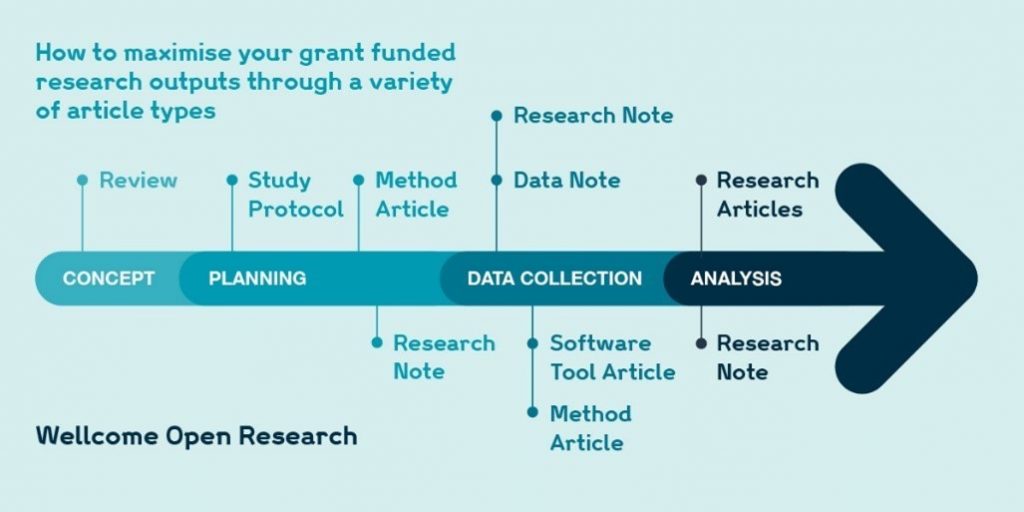
By publishing every output of a research project as a standalone article type, you can get full credit for the hard work that goes into each step of a project. Additionally, publishing research outputs from earlier stages in a project can help to prevent duplication and research waste, while enabling others to build upon existing work. This, in turn, increases the efficiency of future projects and scientific advancements.
In this blog post, we outline 5 additional opportunities to publish outputs from your research journey with Wellcome Open Research.
Reviews
Formulating a clear research question and reviewing related existing literature is vital to any research project, allowing the conceptualization of new work. Reviews are a balanced and comprehensive overview of the latest discoveries in a particular field. They should cover a particular research area from a new angle, focusing on peer reviewed journals and papers.
A review shouldn’t contain any new research, instead focusing on existing published findings. They provide researchers with the opportunity to evaluate the work of others and identify the limitations of existing research, potentially identifying new avenues for future studies.
A well-written review could be invaluable for you and other researchers. Publishing a review article demonstrates your understanding and expertise in your field, and there is a chance that other researchers will find, read and cite your work, resulting in academic recognition.
We’ve included some examples of review articles published on Wellcome Open Research below:
- Trace amine-associated receptor 1 (TAAR1) agonism for psychosis: a living systematic review and meta-analysis of human and non-human data
- Community-Based Health Information Systems in Africa: A Scoping Review of Data Generation, Utilization, and Community Empowerment
Study Protocols
Study protocols allow researchers to propose their methods for future studies and present their rationale. They describe in detail a proposed study design, including the experimental design of basic and applied research, systematic reviews, or protocols defining research questions and empirical methods.
Study protocols are an excellent opportunity for researchers to receive feedback on their methods before undertaking their practical investigations, potentially pointing out any flaws in the methodology. In addition to this, authors can request specific feedback during the peer review process to further optimize their work. By publishing a study protocol before carrying out the investigation, it allows other researchers in your field to see what you will be working on.
We’ve included a couple of examples of published Study Protocols below:
- A protocol for a living mapping review of global research funding for infectious diseases with a pandemic potential – Pandemic PACT
- A human model of Buruli ulcer: Provisional protocol for a Mycobacterium ulcerans controlled human infection study.
Method Articles
Method articles describe a new method, test or procedure. They tend to include new study methods, or substantive modifications or innovative applications of existing methods. Alternatively, they may also take the form of technical articles that describe tools that facilitate the performance of experiments or provide data analysis.
They allow researchers to gain feedback on their method, including whether there is adequate detail to reproduce and use the method. This in-turn upholds the reproducibility and transparency of the procedure, as well as demonstrating new methods or improved methods which can be used by other researchers and applied to their projects.
Below are some examples of Method Articles published on the platform:
- The Rapid Assessment of Avoidable Blindness survey: Review of the methodology and protocol for the seventh version (RAAB7)
- Development of a conceptual framework to understand the stakeholder’s perspectives on needs and readiness of rural tele-practice for childhood communication disorders
Data Notes
Data notes give researchers the opportunity to share research datasets in a discoverable, useable and reproducible way, while giving credit to the researchers producing the data in a citable publication. They are brief descriptions of scientific datasets and often include details of why and how the data was created, however they do not include any additional analyses or conclusions.
The data on which a data note is written is often deposited in a repository, so it can be verified and stored. By making this information available, it promotes the potential reuse of research data by other researchers.
Below is an example of a data note published on Wellcome Open Research:
- The genome sequence of Rhynchonycteris naso, Peters, 1867 (Chiroptera, Emballonuridae, Rhynchonycteris)
- The genome sequence of the nematode Caenorhabditis drosophilae (Rhabditida, Rhabditidae) (Kiontke, 1997)
Software Tool Articles
Like Data Notes, Software Tool Articles aim to ensure maximum reproducibility of software, code, and algorithms.
Rather than relegating software to a section of a final paper, this enables researchers to present cutting-edge software as a standalone output.
A Software Tool Article should include the rationale for the development of the tool and details of the code used for its construction. The article should provide examples of suitable input data sets and include an example of the output that can be expected from the tool and how this output should be interpreted.
We’ve included an example of a Software Tool Article published on Wellcome Open Research below:
- Riboseq-flow: A streamlined, reliable pipeline for ribosome profiling data analysis and quality control
- testCompareR: an R package to compare two binary diagnostic tests using paired data
There are many ways to get the most out of your research, which align with the principles of open research, such as collaboration, transparency and reproducibility. Learn more about telling the full story of your research with diverse article types on Wellcome Open Research.