5 simple steps to get your research ready for submission to Wellcome Open Research
| 22 January, 2024 | Kathryn Beechey |

All Wellcome-funded researchers can publish their research with Wellcome Open Research with no author-facing fees. To help you with the process, we’ve created a checklist with the steps you need to take to get your research ready to submit to Wellcome Open Research.
Step 1: Check your eligibility to submit research to Wellcome Open Research
There are a number of criteria that publications need to meet to be eligible to publish on Wellcome Open Research:
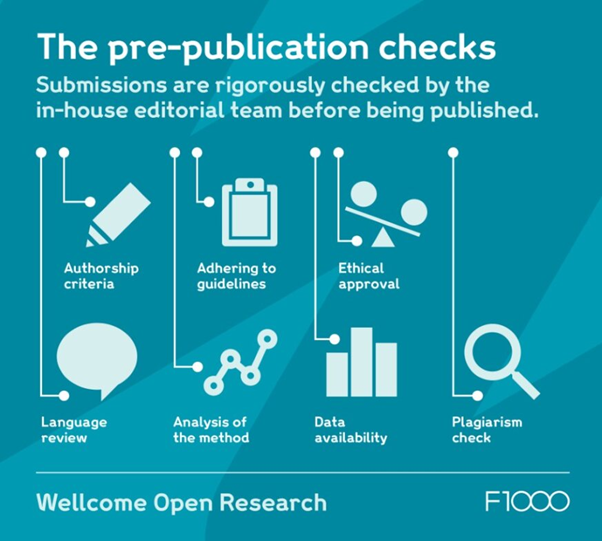
- Author criteria – at least one author is funded or co-funded by the Wellcome Trust. Or has been in the past, and that the article is a result of this funding. Have your grant ID ready, as you will need to enter it on the submission form.
- All articles must be original and not duplications of work that has been published previously or is currently under consideration or review elsewhere for publication (excluding work posted on a pre-print server). If there is significant overlap with another paper, this must be cited in the article and mentioned on submission.
- All listed authors must have made a clear contribution to an article. Anyone who has contributed but does not meet the criteria for authorship can be listed in the ‘Acknowledgements’ section.
- All research must be scholarly work based on scientific, translational, applied, or clinical investigation.
Step 2: Prepare your paper
Our editorial team undertakes thorough pre-publication checks for each article that is submitted. There are a few things to prepare for your paper to ensure it meets these pre-publication requirements.
Article guidelines
Wellcome Open Research accepts a broad range of traditional and non-traditional article types for publishing, from Research Articles to Data Notes and Software Tool Articles.
Each of these article types has its own requirements to meet, so it’s important that authors check the respective article guidelines for their work.
For example, clinical trials within a Clinical Practice Article or Case Report need to be registered in an approved register.
Ethical approval and consent
All articles must comply with our ethical policies. For example:
- Work involving humans must adhere to the principles expressed in the Declaration of Helsinki.
- Research with animals must follow ARRIVE principles and comply with the Convention on the Trade in Endangered Species of Wild Fauna and Flora.
- Research involving plants must be in compliance with the Convention on Biological Diversity and the Convention on the Trade in Endangered Species of Wild Fauna and Flora.
Similarly, all appropriate ethics approval must be obtained in advance of the study where required.
Competing interest statement
All papers must include a competing interest statement. Where competing interests are identified, this will not inhibit publication but will help to provide full transparency for reviewers and readers.
Language quality
Articles on Wellcome Open Research need to be well-written, and language quality shouldn’t impede understanding of the research. If we think an article needs language editing to improve readability, our editorial team will recommend professional copyediting services before the paper can be accepted.
Reproducibility
All articles must adhere to standards of reporting guidelines to ensure they have provided a clear and comprehensive description of research, including clear methodological details, to make it easier for others to assess and reproduce the work.
These standards of reporting can vary by article type. For example, specific guidelines for Systematic Reviews and clinical trials, so it’s important to review these before submission.
Step 3: Prepare and deposit your data
Open data is a key element of open research. Not only enabling reproducibility of research by the wider academic community, open data also enables greater transparency in the full research process, boosts research visibility, can increase citations, and improves trust in findings.
As a result, Wellcome Open Research requires all data to comply with our open data policy. This ensures that all underlying data is made open where possible.
FAIR Guidelines
Wellcome Open Research is committed to open data and endorses the FAIR Data Principles alongside our data policy to achieve this.
The FAIR Principles provide a framework for data to be:
- Findable – hosted in a stable and recognized open repository, assigned a globally unique persistent identifier, such as a DOI, and described using associate metadata.
- Accessible – openly published under the CC0 license or an OSI-approved license for software and source code, enabling data reuse.
- Interoperable – stored in a non-proprietary open file format and described using a standard vocabulary where available, to enable maximum interoperability.
- Reusable – all of the above steps help ensure that people who are not familiar with the original data and research can understand and reuse it based on the metadata, additional documents, and open format.
However, we recognize that not all data can be made open, for example confidential, ethical or proprietary third-party data, and we have specific policies in place to account for this. Please see the data policy for more information.
Preparing your data to submit your research to Wellcome Open Research
To meet these guidelines, there are a number of steps to take:
- Prepare your data for sharing
- Deposit your data in an appropriate repository
- Add a Data Availability Statement to your article
One of the most common reasons why articles are rejected from publication is that the supporting data is not openly available. As a result of this, we strongly encourage all authors to review these guidelines and our data policy before submission.
Steps 4 and 5: submit research to Wellcome Open Research and identifying peer reviewers
Once you’ve prepared your paper and data, you can submit your research for publication using our simple online form.
As part of this, you’ll need to suggest five suitable peer reviewers. You’ll have the choice to select reviewers using the Wellcome Open Research reviewer finding algorithm. This scans the article and reference list to identify researchers who may be suitable to review, or you can choose your own reviewers. Read our tips for finding article reviewers for your research.
The editorial team will facilitate the peer review process and contact reviewers on the author’s behalf. They may also suggest suitable reviewers where required.