Putting on a show – a creative approach to engage the public in health research
| 3 June, 2021 | Gladys Sanga |
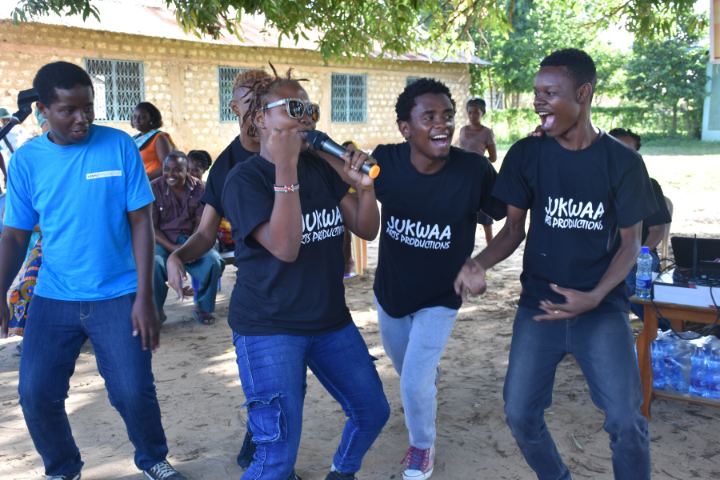
For decades, the theatre has been used as a creative approach for fostering community engagement. The performing arts can break down hierarchies, allow different perspectives to be shared in a safe space, and facilitate cross-learning. Researchers exploring new ways to make research more accessible, have also been turning to the performing arts.
To engage the public in health research, researchers are using drama to reduce barriers and increase trust to raise awareness about health issues and health policy. To discuss the value of community and public engagement in health research, we invited Gladys Sanga, KEMRI-Wellcome Trust Research Programme, Kenya, to learn how health research can be made appealing and accessible to the public.
In this blog post, Gladys tells us about the entertaining project ‘Always leave the audience wanting more’, funded by Wellcome, to facilitate engagement between KEMRI-Wellcome Trust Research Programme researchers and public audiences in Coastal Kenya.
Could you tell us a little more about your field of research?
I have worked at the KEMRI-Wellcome Trust Research Programme (KWTRP) for over 17 years as a field worker, progressing to an Assistant Research Officer in the Health Systems and Research Ethics Department. I hold a bachelor’s degree in Community Development (Pwani University, Kenya). My roles include social science research and monitoring & evaluation of Community & Public engagement. My interests are in the ethics of involving vulnerable groups in research, and the value of community and public engagement in health research.
Why is public engagement important?
Public engagement is increasingly promoted for conduct of biomedical research. It provides a means of supporting research and enables researchers to express respect and nurture trustworthiness in their work. Public engagement is important as it strengthens relevance, responsiveness and accountability of research, and gives people an opportunity to share their views and concerns about research.
Your recent Research Article is about the Magnet Theatre. What is this forum?
Magnet Theatre (MT) is a specific form of participatory community theatre that is conducted at a specific time and venue within the community, over an extended period. Its distinct feature is that the drama is paused at a point of dilemma and the public audience is invited to reflect on the problem, discuss possible solutions to the dilemmas and enact the solutions they suggest.
How has MT created social and behavioural change?
The approach has been used in different fields for health education and health promotion. It has been used for decades in grass-roots community HIV interventions across different countries to raise awareness, promote social and behaviour change and incorporate public views into planning and implementation of interventions. It is identified as a one of the best practices in HIV prevention. However, MT has not been used in health research to foster community engagement.
Why is drama a useful tool to engage communities with health research?
We felt that MT would provide an enjoyable way to enable members of the public to engage with health research and freely share their views about research outside the potentially intimidating confines of the research institution.
What inspired you to carry out this study?
People enjoy drama in Kenya, and we wanted to make engagement as appealing and accessible to the public as possible. Given theatre’s widespread success in health promotion and policy engagement, we felt that MT would be appropriate for public engagement and that it had the potential to strengthen public understanding of research and foster co-learning between researchers and the public. We monitored and evaluated MT to document public views and concerns about research and assess its influence on public perceptions of KWTRP.
Where and how was the programme implemented?
Co-learning was at the heart of this initiative. Sites for the performances and drama themes were informed by discussions with community members and drama scripts were co-written with research staff and the theatre group. Dramas were performed on a regular basis in a rural and urban site on the Kenyan coast.
What type of health research was covered in the performances?
The drama themes aimed at addressing several questions including: Why does KWTRP take blood samples?; Do research participants get paid to participate?; and Why do people refuse to participate in research?
Did this public engagement approach help raise awareness and understanding of health research among communities?
We learnt that MT conveyed research in familiar ways, enabling researchers to learn from wider publics. Participants reported that the dramas were entertaining, were real and though they evoked emotions, people still enjoyed and learnt from the performances. Workshop participants felt that learning about KWTRP’s work enabled them to reconsider rumours about the research institute and changed their attitudes towards research. Participants also reported gaining an awareness of KWTRP’s work and for some, this alleviated their fears about KWTRP.
Why is it important that researchers participate in the frontline of engagement activities with communities?
Participating research staff reported that they gained an appreciation of community concerns related to their research work, and from our point of view, this is important. We presented evidence in the manuscript that involving ‘expert researchers’ in MT performances supports learning for both audiences and participating researchers; however, persuading researchers to participate proved challenging. Whilst recognizing the busy schedules of researchers, we feel that the importance of involving them at the engagement ‘frontline’ cannot be understated. Their presence not only adds credibility to the messages conveyed, but equally important, provides a demonstration of willingness to be part of a community.
Are there any challenges to this approach?
Various challenges were encountered during the implementation and evaluation of the MT approach. Identifying suitable sites requires a careful balancing of selecting places which are busy enough to attract a sizeable audience whilst not being too noisy for engagement. Maintaining a consistent group of actors throughout the implementation of the initiative was also a challenge. Community members reported learning from the dramas, but some expressed a concern that the number of performances were insufficient, we interpreted this as the audience enjoying the performances enough to desire more.
Why did you choose to publish this Research Article on Wellcome Open Research, an open access and open peer review platform?
We had two reasons for selecting the Wellcome Open Research platform to publish our work: the first is that because of its rapid on-line review process, we were able to share our work widely and very quickly without any delays in waiting for reviewers; and secondly because it’s open access and colleagues from all over the world would be able to download the article freely. This is a particularly important value for us.
“The paper describes the development, process and evaluation of this community engagement strategy including consideration of the logistics that may enhance or impede engagement through this approach. The benefits of Magnet Theatre are clearly demonstrated and the challenges in implementing the approach considered,” states Nicola Desmond, Liverpool School of Tropical Medicine, UK, in her review of the article.
You can read the full Research Article and the peer review reports via Wellcome Open Research, ‘Always leave the audience wanting more: An entertaining approach to stimulate engagement with health research among publics in coastal Kenya through ‘Magnet Theatre’ >>