Seven tips for getting the most out of your publishing experience
| 21 August, 2023 | admin |

Publishing your research can feel like a daunting task, whether you’re publishing for the first time or the 50th time. From identifying the right article format and journal to participating in the peer review process, there are several stages to any publishing experience.
When publishing with Wellcome Open Research, our friendly and experienced editorial team is on-hand to help authors at every step of the journey. Here, we’ve rounded up seven tips and tricks for getting the most out of your publishing experience from F1000 Senior Associate Publisher, Sheridan Willis.
Getting your paper accepted
Tip #1: Choose the correct article format for your research
One of the first decisions you must make is the format in which you would like to publish your work.
Traditional Research Articles tend to make up the bulk of published work and have long been seen as the pinnacle of any research project. However, this can undermine the value of other article types, and not all research is suited to being published as a Research Article.
For example, clinical studies may be best represented in a Clinical Practice Article, or innovative data or software best published as a Data Note or Software Tool Article.
As a result, it’s key to understand the different article types available for publishing your research. At Wellcome Open Research, authors can publish their work as 13 different article types, each of which is designed to support a different research phase.
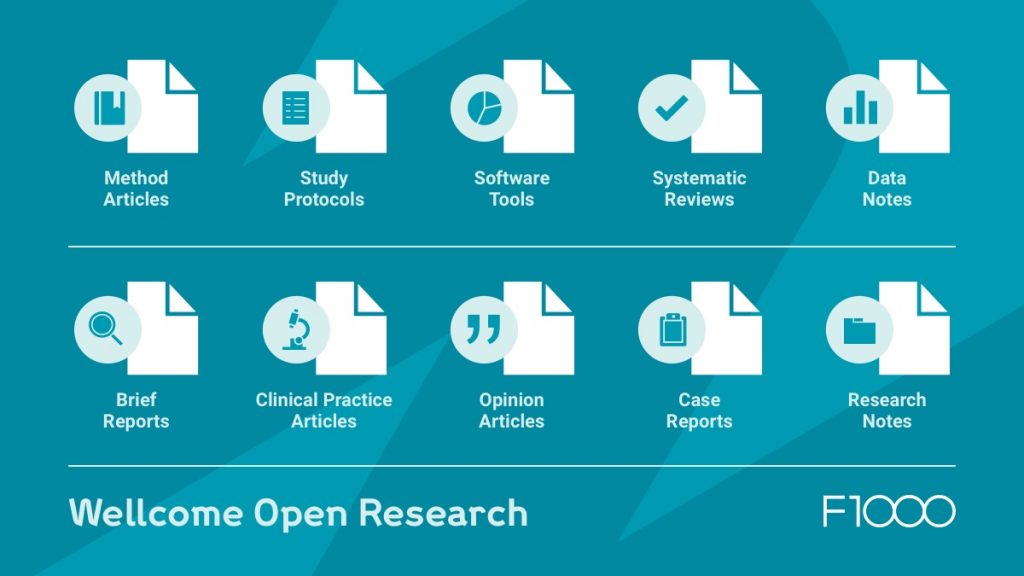
Tip #2: Choose the most appropriate publishing venue
Alongside the decision about article format, you also need to decide which journal is best suited to your research.
Sometimes, the article format you choose will help decide this, as not all publishing venues will support all article formats.
Other times, it should be guided by the ethos and approach of the journal, and whether this aligns with what is important to you as a researcher.
While journal-level metrics like Journal Impact Factor have long been the deciding factor in choosing a journal, we would recommend looking beyond this and thinking about things like:
- Can you see yourself in the journal’s existing content or authors?
- Are there studies of similar size or methodology?
- Does it offer the level of editorial support you need?
- Does it operate editorial or research principles you wish to support, e.g. open access or open peer review?
- Does it support important elements of your research, e.g. the ability to publish large datasets?
- Does it comply with funder or institution requirements, e.g. mandated open access?
Additionally, considering these elements before submitting your work can also help you understand the likelihood of your article being accepted by the journal, particularly whether you can see similar content, studies, or authors already published.
Tip #3: Read all the article guidelines, journal policies, and funder policies thoroughly
Once you have decided on your article format and journal, it’s important to read the article guidelines and policies thoroughly. Every publishing venue is different, so it’s important to do your research to understand the specifics of your chosen journal.
Things to consider include:
- What are their article guidelines and publishing policies?
- What is the publishing process?
- What pre and post-publication checks will you be required to meet, and how can you best prepare for those?
Wellcome Open Research, for example, requires data sharing as part of the submission process, has a set of pre-publication checks to pass, and conducts peer review after publication, as opposed to before publication.
Reading the guidelines and journal policies in detail will save you time in revisions and resubmissions.
Similarly, funders have their own specific policies when it comes to publishing research. Wellcome, for example, mandates open access for publications resulting from Wellcome funding and supports open data, which is important to understand when submitting research for publication.
Post-acceptance
Tip #4: Be responsive to editors and develop good relations with the team
Once your paper has been accepted for publication, you’ll communicate with publishing teams at multiple stages of the process, from initial checks to proof reviews and queries. Responding in a timely manner and providing comprehensive feedback is key to developing positive relationships.
Additionally, it’s important to manage expectations with editors if there are likely to be any delays, which can help avoid frustration or confusion on both sides.
If there are likely to be lengthy delays, consider appointing a co-author who can arrange responses in your absence.
Undertaking peer review
Tip #5: Be thorough in responses
When revising your paper following peer review, make sure to be thorough in your responses.
Address each point in turn and provide a full response, including an explanation of any changes made to the paper in light of the comment.
This is especially important in open peer review, a key element of Wellcome Open Research, where peer review comments, reviewer names, and author responses are open.
By providing detailed responses, you can build a relationship with both your reviewer and your readers, providing more transparency and boosting credibility of your work.
Tip #6: Feel empowered to say no
You do not always need to agree with your reviewers and should feel empowered to say no, where you feel appropriate.
In these instances, you should provide a detailed response explaining why you disagree and use it as an opportunity to provide any further evidence or explanation that may support your response.
Reviewers may have expertise in this area, but there are always opportunities for learning on each side.
Tip #7: Be prepared for multiple rounds of review
Finally, it’s important to be prepared for multiple rounds of review and revisions – don’t be disheartened by this, and instead see it as a learning opportunity to improve your knowledge and writing skills from experts in your field.

Publish your work with Wellcome Open Research
From supporting multiple article types to providing comprehensive editorial support and guidelines, Wellcome Open Research provides a reputable, publishing venue for those looking to publish their latest Wellcome-funded research – at no cost to authors.
Learn more about the Wellcome Open Research publishing process and, if you’re ready to submit your research to the platform today, find out more about the submission process.