Looking back at 2022: a year in review of Wellcome Open Research
| 14 December, 2022 | admin |
As we approach a new year, we’re looking back at 2022 and some of the achievements of Wellcome Open Research and its authors, as the Platform continues to go from strength to strength in supporting the Wellcome research community.
We’re also exploring the five most-read articles of the year and some of the key research themes of 2022 on Wellcome Open Research.
Read on to find out more.
2022 in numbers
With Wellcome Open Research approaching six full years of publishing articles, the Platform continues to go from strength to strength in supporting the Wellcome research community, which is reflected in the success of this year.
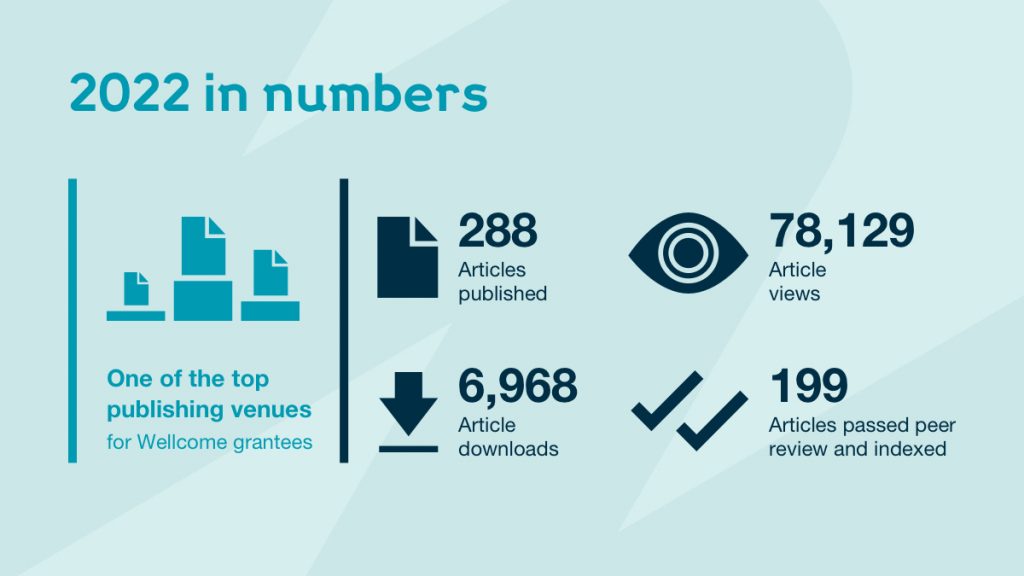
Retaining its spot as one of the most popular publishing venues for Wellcome-funded researchers, 288 articles had been published on the Platform in 2022 at the time of writing.
These share insights across a range of research topics, from machine learning methods in paediatric chest radiographs to the use of yoga to improve maternal mental health and immune function during the COVID-19 pandemic.
199 of these articles have also gone on to pass peer review and be indexed in PubMed Central, Scopus and other indexing databases.
Articles published in 2022 have accrued almost 80,000 views and almost 7,000 downloads over the year – reflecting the significant visibility of articles published on the Platform and the benefits for authors in reaching wider audiences when publishing open access.
Research published on the Platform in 2022 strongly aligned with Wellcome’s key strategic priorities, particularly infectious diseases and tropical medicine.
However, we also saw other key research themes emerge – such as genomics and the Tree of Life project – and a continuation of other major trends, including healthcare and COVID-19 more specifically.
The importance of a variety of article types
One key benefit of Wellcome Open Research for researchers is the ability to publish a range of article types, from traditional Research Articles to Method Articles and Study Protocols.
This ensures that all research outputs can be published at different stages throughout the research journey, thus reducing research waste, while also enabling greater reproducibility and trust in the findings.
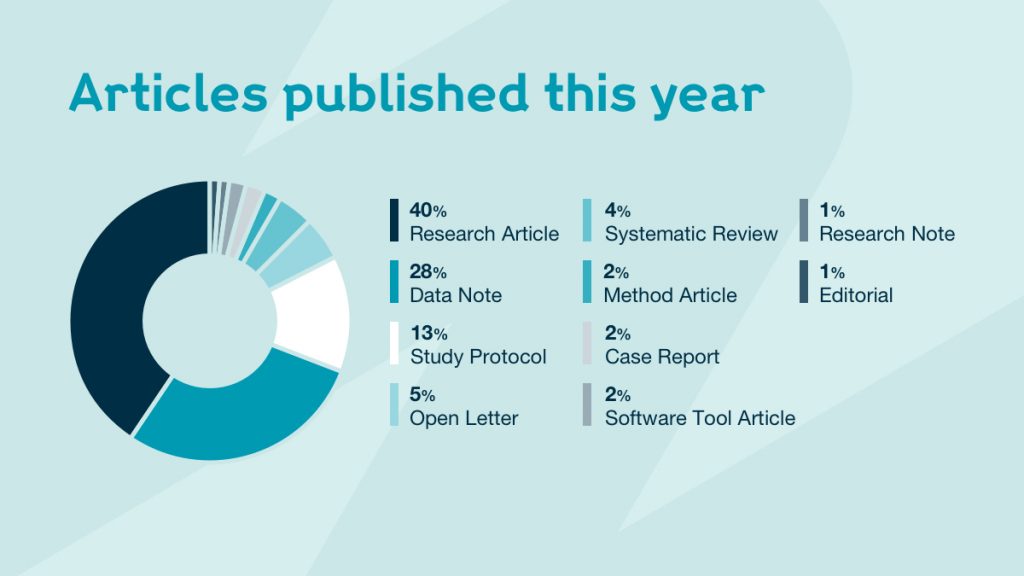
While Wellcome Open Research is already well established as a publishing venue for traditional Research Articles, with 113 published this year so far, we saw 11 other article types published in 2022, including 79 Data Notes, 37 Study Protocols, 14 Open Letters, six Systematic Reviews, and two Method Articles.
This year’s five most-read articles
Articles published on Wellcome Open Research this year covered a whole range of research topics and themes, and we’ve identified the most-read articles of 2022.
Topping our most-read article list is a Research Article exploring the role of arts engagement in improving health and wellbeing, with 2,237 views since its publication in January 2022.
The study examines what it is exactly within arts engagement that can have these positive effects and tries to identify the active ingredients within a successful arts-in-health program, with the aim to support the design, implementation, and evaluation of future arts-in-health activities.
Connected Bradford: a Whole System Data Linkage Accelerator
Our second most-read article, with 1,241 views, introduces the Connected Bradford Whole System Data Linkage Accelerator project and its related dataset and framework, which was set up to link health, education, social care, environmental, and other local government data.
The article is part of the Born in Bradford Gateway and has linked data spanning over forty years for 800,000 individuals using the pseudonymized NHS number and other data variables, providing a significant clinical database for use in health research in the UK.
Living HTA: Automating Health Economic Evaluation with R
Our third most-read article is a great example of the benefits of publishing diverse article types with Wellcome Open Research and how publishing your methods as part of the research journey can help boost the visibility of research.
This Method Article has had 1,081 views since its publication in July 2022 and demonstrates how a new automated workflow for health economic modelling can more easily enable analyses of data, without the need for direct access – both ensuring the protection of sensitive data and reducing manual document revisions.
Another Method Article comes in at number four on our most-read list, which has received 825 views in 2022 and presents a new type of online survey to improve the construction of EQ-5D-5L value sets.
The article highlights that standard valuation methods, such as TTO and DCE, are inefficient, requiring data from hundreds, if not thousands, of participants to generate value sets. Instead, this new survey uses more efficient, compositional elicitation methods, which can even allow estimating value sets at an individual level.
The EWAS Catalog: a database of epigenome-wide association studies
With 838 views,our final article introduces the EWAS catalog – a database of over 1,700,000 associations from over 2,600 epigenome-wide association studies (EWAS).
The Software Tool Article highlights the need for a more accessible way to use the rich data being published from the rapidly expanding number of EWAS, and presents the new database – accompanied by a web-based tool and R package – which will enable researchers to more quickly and easily query EWAS associations.
Looking to the future
We want to take this opportunity to thank all the authors and peer reviewers who have published and reviewed with Wellcome Open Research this year.
We look forward to seeing more cutting-edge research published in 2023, and to welcoming more authors to the Platform.
We’d also like to thank our Gateway and Collection Advisors, who provide vital input and strategic direction to the research themes highlighted on Wellcome Open Research, as well as our expert Advisory Board.
If you’re new to Wellcome Open Research and would like to learn more, or are just looking for more information on the Platform and how it works, visit the website for more information and what you can expect when submitting your research.
“This year proved to be another great success for Wellcome Open Research.
We reached the incredible milestone of 1,000 articles passing peer review and subsequently being indexed in databases such as Scopus, PubMed, and Medline –significantly increasing the discoverability of authors and their research.
We also merged our Senior Advisory Board and Early Career Advisory Board into one single Board, ensuring that all researchers, at whatever stage of their career, have an equal say in the strategic direction of Wellcome Open Research.
I look forward to seeing what 2023 brings for Wellcome Open Research and its continued adoption by Wellcome-funded researchers.”
Sheridan Willis, F1000 Senior Associate Publisher