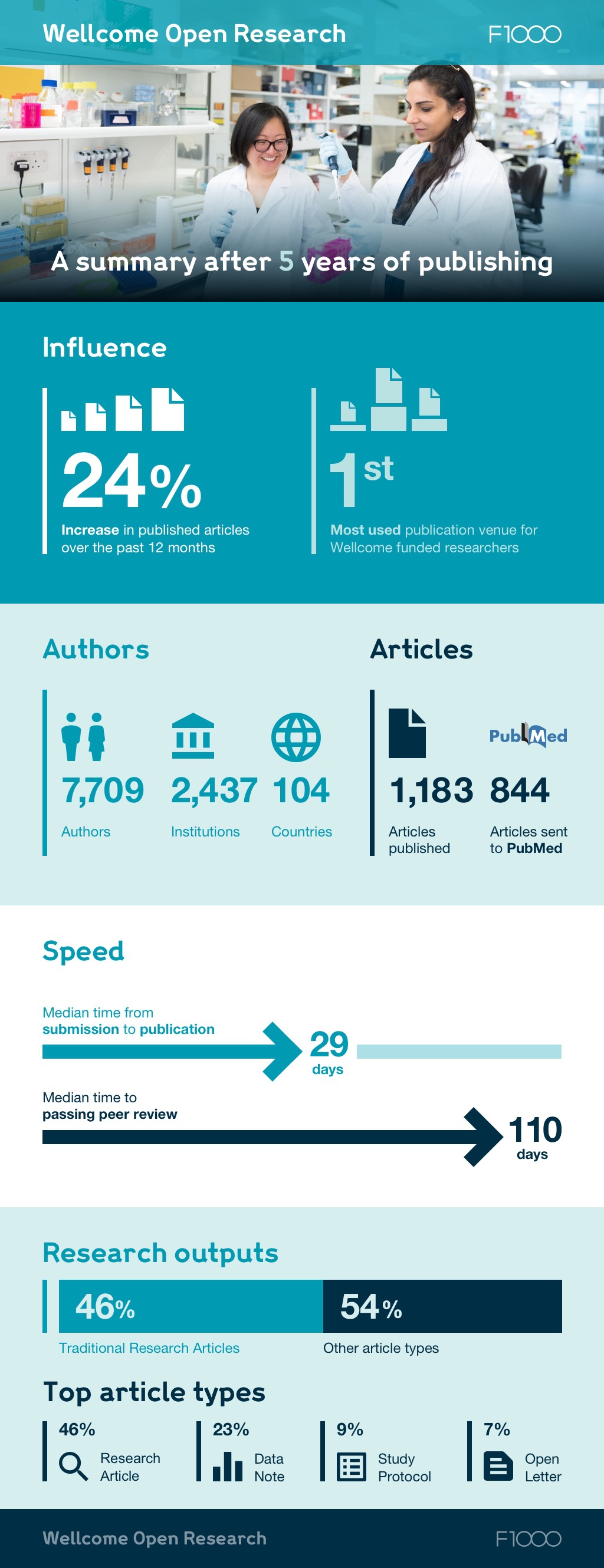
Wellcome Open Research: Highlights from 5 years of publishing
| 22 March, 2022 | Hannah Hope |

2021 marked another successful year for the Wellcome Open Research (WOR) publishing platform. Publication output on WOR continued to grow, with the diversity of research outputs published increasing. The Platform showcases the broad portfolio of research that Wellcome funds.
In this blog, Hannah Hope, Open Research Lead at Wellcome Trust, provides an overview of WOR’s publishing activity of the past year as well as the initiatives we plan to implement in 2022.
Year 5 in numbers
In 2021, the total number of articles published on WOR increased by 24% compared with 2020, with over 360 new articles published. This number also accounts for 30% of the total number of published articles since the Platform’s launch in 2016, and brings the grand total up to almost 1,200.

This growth has enabled us to continue to be the most used publication venue (by volume of articles) for Wellcome-funded researchers according to Europe PMC and Dimensions data.
Some of this growth has been driven by the extensive use of the platform by our researchers studying the COVID-19 pandemic, demonstrating the value of rapid, open publishing in times of global crisis.
COVID-19 research on Wellcome Open Research
For the second year in a row, the Platform hosted an array of insightful COVID-19 papers, including:
- A modelling study by Hanlon et al. which explored the implications of long-term condition type and extent of multimorbidity on years of life lost. Originally published in 2020, the paper was revised twice in 2021, with the authors using the revision option to highlight the need to interpret the policy-relevance of the findings in the context of their limitations.
- A Research Article by Catty discussed the varied impacts of lockdown on adolescents, their parents, and the psychotherapists who work with them. This short observational paper is also a contribution to the Waiting in Pandemic Times Wellcome Collection in response to COVID-19.
- A living mapping Review by Norton et al. has taken advantage of the versioning functionality on the Platform to regularly summarize the global COVID-19 funded research portfolio as it aligns to the WHO and Global Research Collaboration for Infectious Disease Preparedness (GloPID-R) Global Research Roadmap: 2019 Novel Coronavirus. The Systematic Review supplements an open and live database maintained by the authors.
These are all available in the Coronavirus (COVID-19) Collection which continues to welcome the latest research related to the pandemic from all research disciplines.
Outputs from across the research life cycle
This year, we also saw significant growth in the publication of novel article types, with researchers choosing to tell the full story of their research by embracing formats beyond traditional Research Articles – one of our primary goals for setting up Wellcome Open Research.
For the first time, Research Articles accounted for less than 50% of the total number of articles published on the platform, giving way for other outputs including Data Notes, Systematic Reviews, and Study Protocols.
By offering several publishing options through different article types, the WOR platform serves the community by allowing researchers to get credit across the research lifecycle, and boost the discoverability of their work by showcasing more of their project.

In the spotlight: Data Notes
Over the past year, the number of published Data Notes on the WOR platform increased by 360% from 18 in 2020 to 83 in 2021. This growth is strongly associated with the launch of the Tree of Life Gateway, which we will discuss in more detail below.
Data Notes are short descriptions of scientific datasets promoting the potential reuse of research data. They explain why and how the data are created, but do not include any analyses or conclusions.
Apart from genome sequences, the WOR platform served as the hub for other notable Data Notes including:
- Home-based antibody testing results from researchers at the university of Bristol
- COVID-19 related questionnaire data on physical and mental health, lifestyle, employment and finances
- Details on the processes required for researchers to access congenital anomalies (CAs) data from Taylor et al.
All 3 Data Notes are available in the Avon Longitudinal Study of Parents and Children (ALSPAC) Gateway which hosts research on the factors that affect a person’s health and development through birth cohort studies.
On the rise: Systematic Reviews
Systematic Reviews usually typically cover medical interventions, animal model studies, and humanities or social sciences studies. The article type addresses a clearly formulated research question and identifies, selects, and critically evaluates relevant research using systematic and explicit methods.
Over the years, Systematic Reviews have been steadily increasing in number on WOR. This article type has risen from 6 publications in 2017 to 14 publications in 2021.
In addition
to the systematic review highlighted above, another Review that stood out was
conducted by Woods and Pinfield, and concerned the efficacy
of different interventions to promote open data practices. This work contracted
by Wellcome, is a topic WOR greatly advocates for through their policies on open data and sharing source data.
A growing trend: Study Protocols
A Study Protocol is a document that proposes a study’s design, research questions, methods, objectives, and statistical considerations for data analysis.
This article type has seen tremendous growth since the platform’s launch. In 2021, 33 Study Protocols were published on WOR, compared with just 4 in 2016. The publication of study protocols is a component of Wellcome’s Clinical Trials policy, introduced in 2016, in line with the WHO Joint Statement on public disclosure of results from clinical trials.
One 2021 Study Protocol published last year proposes a methodology for exploring the research gap on the impact of delivering specific nutritional support following severe pneumonia in children. The much-needed research this Study Protocol sets out a methodology for could make a huge impact on the health of children across Sub-Saharan Africa, where pneumonia is currently the leading cause of childhood death.
You can read this Study Protocol and browse others on the KEMRI | Wellcome Trust Gateway, which hosts clinical and social science outputs from three main research hubs in Kenya and Uganda.
The year ahead: a spotlight on genomics
2022 is set to be another exciting year for Wellcome Open Research, with plenty of developments in the pipeline already – but there’s one topic which is already a key area of focus, just 3 months into the new year…. genomics!
As stated above, in 2021 the WOR platform launched the Tree of Life Gateway, an open publishing hub for the Darwin Tree of Life, Aquatic Symbiosis Genomics, and 25 Genomes for 25 years projects, all centered at the Wellcome Sanger Institute.
Already home to more than 80 articles, over time the Gateway will publish the genome sequences of thousands of species following a quicker and automated route. To help achieve this, Wellcome Open Research and the Wellcome Sanger Institute will be launching a new article type called Genome Note which will be subject to automated and community review – a unique, less burdensome, rapid approach compared to traditional peer review.
We encourage all genomics researchers to support the Tree of Life programme as community reviewers and assess the Genome Notes published in the Tree of Life Gateway. Reviewers will get involved in an innovative project within the genomics community, and receive credit for their work, benefiting from WOR’s open peer review process. Early Career Researchers (ECRs) and PhD students are welcome to join the project, and get hands-on experience with peer review, sharpen their reviewing skills, and engage in constructive conversations with the wider research community.
If you are interested in joining the Tree of Life community reviewer group, please sign up here, or contact us at info@wellcomeopenresearch.org.