Wellcome Open Research: a summary of year 4
| 8 February, 2021 | Robert Kiley & Michael Markie |
Introduction
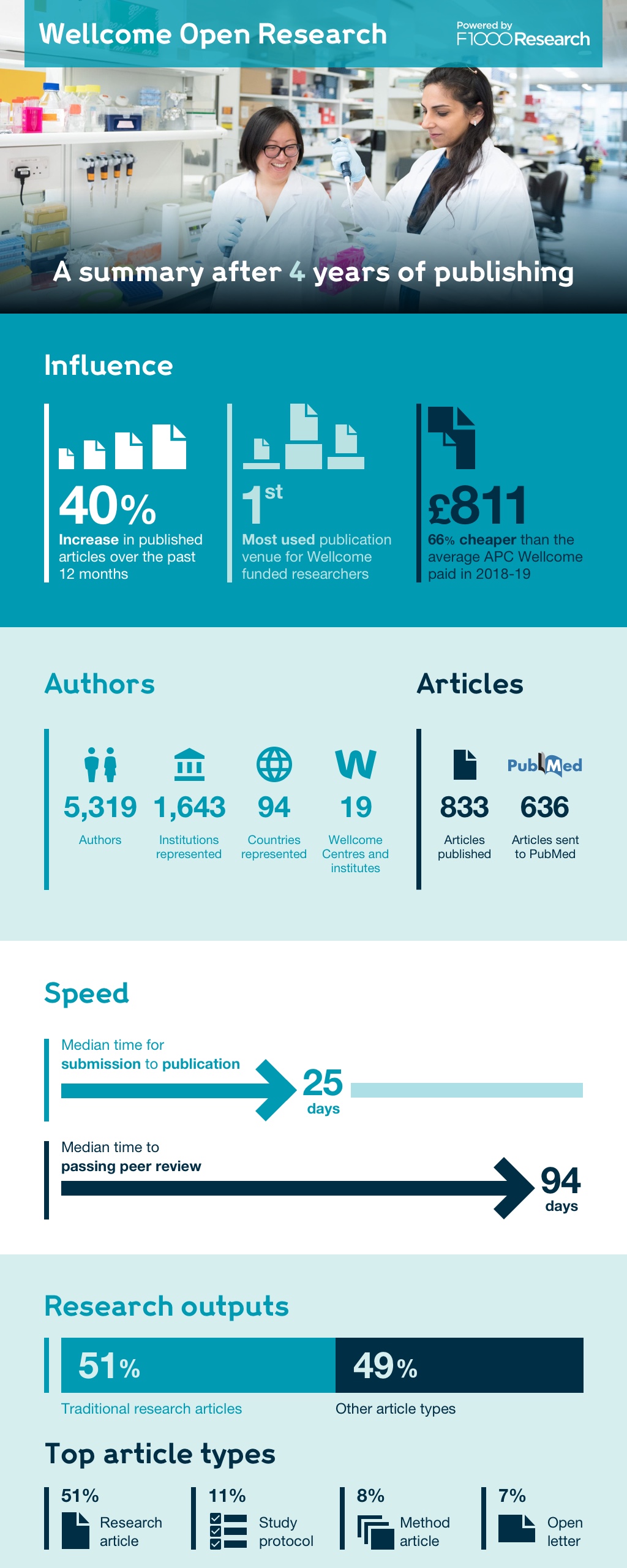
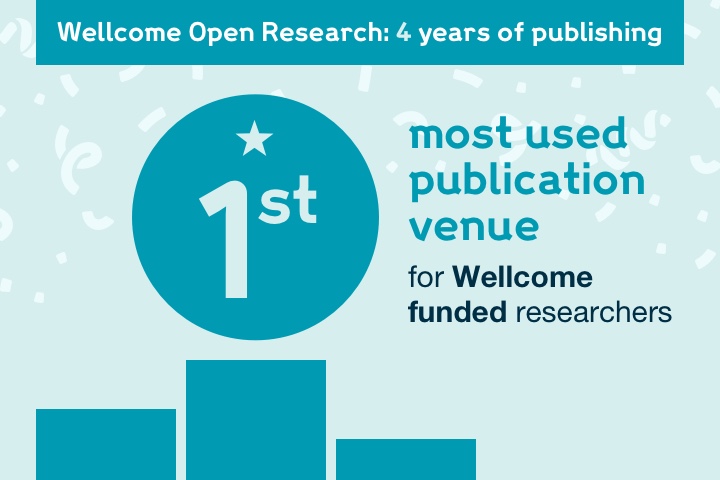
In 2020 the Wellcome Open Research (WOR) publishing platform reached a significant milestone when it became the single most used venue for Wellcome-funded researchers to share their research findings.
In this blog post, Robert Kiley, Head of Open Research, Wellcome, and Michael Markie, Publishing Director, F1000, provide an analysis of publishing activity on the WOR platform and preview some of the initiatives we have planned for 2021.
Year 4 in numbers
2020 witnessed another solid year of growth in the total number of articles of published on this platform, with a 40% increase in the number of articles published, compared with 2019.
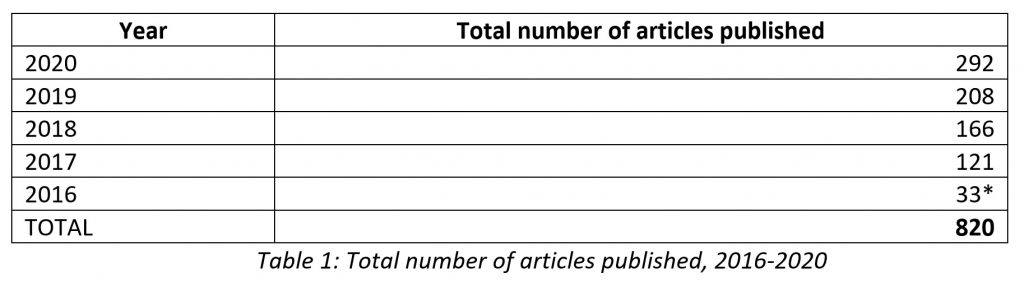
* (Note: articles were accepted from June 2016; the site went live 14th November 2016)
Much of this increase was driven by researchers publishing research related to the COVID-19 pandemic. Publishing a diverse range of content from clinical and biological through to sociological research, some 28% (82) of the articles published in 2020 focused on the pandemic and included several high profile and impactful papers such as:
- a study by Endo, Funk and colleagues that used mathematical models to estimate transmission of COVID-19, which to-date, has been cited 52 times;
- a study by Aldridge and colleagues which showed how Black, Asian and Minority Ethnic groups in England are at increased risk of death from COVID-19 which, to date, has been cited 60 times;
As a consequence of this growth, data from the Dimensions and Europe PMC databases show that WOR is the single most used publishing venue for Wellcome-funded researchers in 2020 (Table 2).
| # | Journal | Number of Wellcome attributed papers published in 2020 (by journal) |
| 1 | Wellcome Open Research | 292 |
| 2 | Nature Communications | 286 |
| 3 | Scientific Reports | 206 |
| 4 | Plos One | 187 |
| 5 | eLife | 166 |
| 6 | BMJ Open | 116 |
| 7 | PNAS | 105 |
| 8 | Nature | 85 |
| 9 | Plos Neglected Tropical Diseases | 73 |
| 10 | Neuroimage | 64 |
Table 2: Top 10 journals (by volume) used by Wellcome-funded researchers
As WOR uses a post publication peer review model, articles are accessible and citable before peer review. Analysis of the 2020 cohort shows that almost half (44%, 128 articles) of them have not yet passed peer review and been indexed in PubMed. However, analysis of the 2019 submissions suggest that over the next few months, the overwhelming majority of the 2020 cohort will likely pass peer review and be indexed. In 2019, of the 208 articles published, 178 of these (86%) have now passed peer review.
Looking across the entire dataset (2016 – end of 2020) we have published articles from over 2331 unique authors (12% authors have published more than once), based in 744 institutions, from 64 different countries.
In addition to publishing research articles, the platform also enables researchers to share other findings – such as data notes, study protocols and null or negative findings. Of the 292 articles published in 2020, some 143 (49%) were non-traditional research articles, which researchers may have had difficulties in getting published in more traditional publishing venues.
Speed of publication remains one of the platform’s unique selling points. Table 3, below, shows that most articles are published within 26 days of being submitted and receive the first peer review report some 21 days later. Once an article has received two “approved” statuses from reviewers (or one “approved” and two “approved with reservation” statuses) articles are submitted for indexing in PubMed, Scopus and other bibliographic databases.
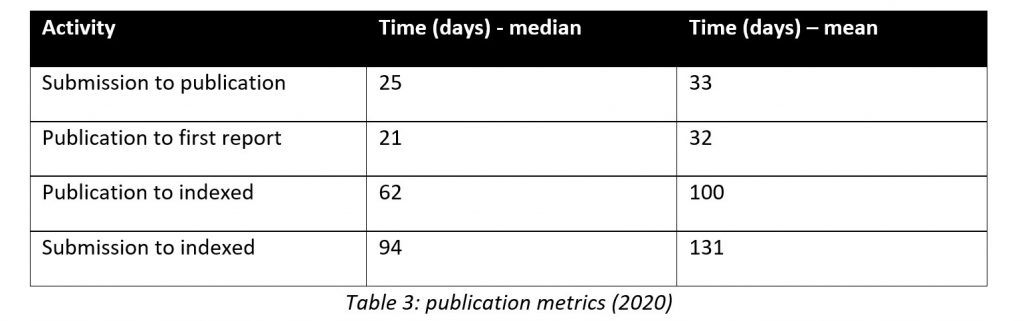
The median, end-to-end elapsed time, from submission to when article has passed peer review, is 94 days. Although compared with many publishing venues this is still fast, the total elapsed time in 2020 is 20% slower than the median elapsed time we reported in 2019, which was 78 days. We are looking to determine the reasons for this, but believe it is related to the large number of COVID-19 papers we published and the industry-wide issue around the difficulty of finding reviewers in a timely way.
Articles on the platform are also well read and cited. To date, some 52% of all articles have at least one citation, whilst the most cited article (a software tool article) has received 216 citations.
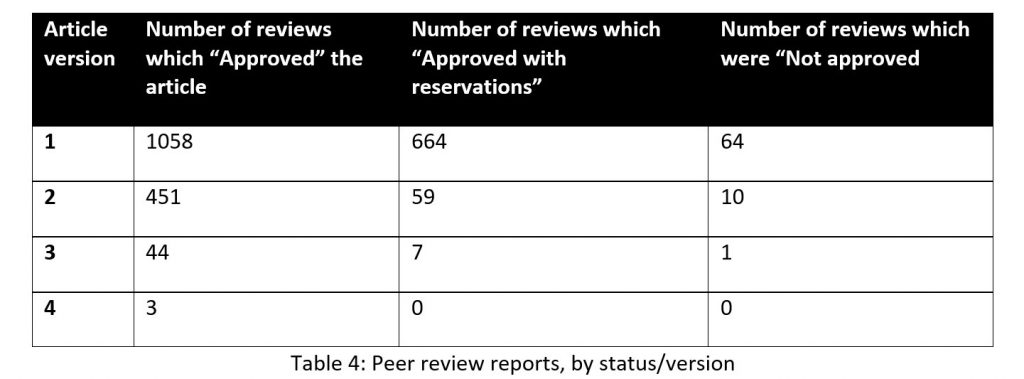
In addition to publishing articles, we also publish every peer review report – and have over 2374 on the site – along with the name of the reviewer and their ORCID iD (when connected by the reviewer).
As well as providing feedback to the researcher on how an article could be improved – remember, reviewers are not having to decide whether the article should be published; that has already happened – reviewers assign a status report to their review (see Table 4). In response to peer feedback, researchers can update their articles and publish a new version.
Another major benefit of this model of publication is lower costs compared to other publishing venues. You can find more information on article processing charges on Wellcome Open Research here.
2020 highlights
Throughout the year our Early Career Researcher Advisory Board (ECRAB) embarked upon a data sharing campaign, with the goal of growing a culture of data sharing to help early career researchers shift towards open research practices.
The ECRAB felt the best way to tackle the issue was to be frank and convey that data sharing is challenging but is ultimately rewarding. The campaign spanned real life stories of data sharing across a range of subject areas, a myth busting piece explaining how to overcome the common hurdles faced when thinking about data sharing, the development of a several how-to-guides (see here, here and here) and a spotlight on how institutional data stewards are a great resource for supporting researchers on data sharing. All these resources are freely available on the data sharing resource page.
This campaign has also culminated in us creating an ECR data sharing guide which will be included in the grant welcome packs for the new Wellcome PhD programmes.
In the summer of 2020, we published a breakdown of our APC’s so researchers (and others) better understand if the fees they pay are commensurate with the publication services delivered, and to better understand the elements of those services for example peer review, editorial work and publishing infrastructure. Making this information available shows our commitment to an open business culture and helps to build awareness of the services and value of the platform whilst building trust with prospective authors.
The year ahead
As highlighted above, the elapsed time to secure peer review reports on the platform were longer than in previous years, particularly on the COVID-19 articles. We intend to continue to work with our publisher colleagues to help pool peer review resources for COVID-19, but we will also be looking to provide more support to authors and reviewers to help streamline the process to relieve some of the burden.
We are also looking forward to working with the Wellcome Sanger Institute’s Tree of Life programme where we are planning an ambitious project to streamline a route to publish the genomic sequences of thousands of species direct from the sequencer to the publication of a ‘genome note’. This project will also include us experimenting with some new flavours of peer review from automatic, machine review and community review.
Finally, we are exploring how best to share different types of research outputs, which typically may not be suited to a traditional publication format, such as Juypter notebooks.
2021 looks to be a busy year for Wellcome Open Research. If you have ideas on how we can help you publish your results in a fast, open and transparent way, we’d love to hear from you.