Price Transparency on Wellcome Open Research
| 1 October, 2020 | Robert Kiley & Michael Markie |

In this blog post Michael Markie, Publishing Director at F1000 Research, outlines the upcoming adjustments to the pricing structure on Wellcome Open Research, whilst Robert Kiley, Head of Open Research at Wellcome discusses the importance of price and service transparency of the platform and how this aligns with the Plan S principles.
Last month, F1000Research rolled out a new pricing structure complete with price transparency. As Wellcome is a cOAlition S signatory, we knew that Wellcome Open Research (WOR) would need to make its pricing structure transparent, so that it meets the criteria of a fully Plan S compliant publishing platform. So, we are announcing a new pricing and service framework for WOR, which ensures a fairer and more representative pricing across all academic subject areas funded by Wellcome while providing full transparency on what those prices comprise of.
2020 marks four years of publication for WOR, and over this time the platform has grown in popularity and size, along with publishing research across the full range of academic subject areas Wellcome supports. F1000 Research have analysed the publications on WOR to determine if the word count pricing structure is representative for all the published content to date. We particularly wanted to see if there was a bias towards the cost of articles in different subject areas that Wellcome fund. Wellcome funds research in the Humanities and Social Sciences which typically produce articles that are longer, so we also wanted to see if the editorial service we were providing aligned with the cost of publishing articles in these areas. The results of this analysis showed that there was room for improvement, and we think the new pricing structure described below better accommodates for a fairer approach to pricing that works across all academic subjects and better represents the editorial service that is required.
We have subsequently combined this work with the article processing charge (APC) transparency requirements necessary for Plan S compliance.
Pricing structure: past and future
APC fees on WOR were previously based on article length, founded on the principle that, in general, shorter articles typically have less data associated with them and should therefore be simpler to conduct the pre-publication checks and be quicker and easier to get peer reviewed compared with longer, full-length research articles.
During the 4 years of running this pricing model, we have learned several things. Firstly, researchers rarely publish single figure findings, but on the occasions, they do, they are often associated with significant research data, meaning that they take no less effort to conduct the pre-publication checks, and are no easier to get peer reviewed.
Secondly, we found that articles that were published with over 8,000 words were typically articles outside medical and health subject areas where it is more common for authors to write longer articles. Moreover, further investigation showed that these articles were not requiring an editorial service that warranted the 1550 GBP price mark.
In short, the logic for basing APCs on word count was not adequately representing the editorial service we provide and was not supportive towards those subject areas that typically have longer articles.
Introducing Article Type Pricing
The way we structure the pricing has now changed from word count bands to article types. To aid the development of this new pricing structure, we analysed the editorial service we provide for each of the article types that we support on WOR. From that analysis, we have created three price categories for our new article type pricing structure. These categories are based on:
• article types that are quicker and simpler to check prior to publication
• article types that are easier to support the authors in the sharing of the underlying data
• article types that are easier to obtain peer reviews for
Figure 1. New Wellcome Open Research pricing structure
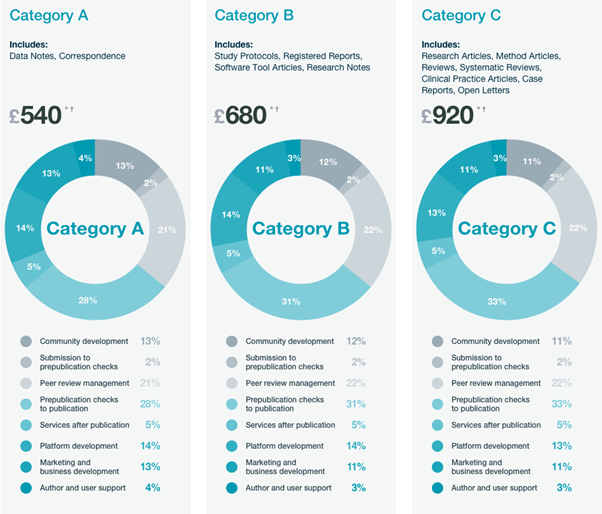
This new pricing will come into effect for all submissions to WOR from 1st October 2020. Wellcome will continue to cover the cost for all article fees centrally.
Price Transparency
Openness and transparency around our pricing align well with our open access policy. It will help researchers (and others) better understand if the fees they pay are commensurate with the open publication services delivered, and to better understand the elements of those services, for example peer review, editorial work, and publishing infrastructure.
Making this information available is also an opportunity for publishers to demonstrate their commitment to open business models and business cultures, to build awareness of their services and value, to build trust with their users and to be more responsive to their needs.
This page shows full price transparency breakdown for each of the new article type categories used at WOR, together with full explanation of the expenditure breakdown in terms of the services provided. The information provided here adheres to the cOAlition S-approved Price Transparency framework developed by Information Power.
This exercise has been important in helping us better understand the prices associated with the various publishing services provided, which in turn helps us to determine whether the APC levied is fair and reasonable.
As part of Plan S, from July 2022 only those publishers which provide price and service data in line with one of the approved transparency frameworks will be eligible to receive OA publication funds from cOAlition S organisations.