The CIDRI-Africa gateway: Combatting infection by making the research widely accessible
| 30 July, 2019 | Claire Whitaker |

The Wellcome Centre for Infectious Diseases Research in Africa (CIDRI-Africa) fosters investigator-led approaches to combat infection, especially HIV-1 and tuberculosis (TB), through clinical and laboratory research.
Claire Whitaker, Communications Manager at CIDRI-Africa and a gateway advisor, tells us more about the CIDRI-Africa Gateway, which hosts articles from researchers based at CIDRI that have been published on Wellcome Open Research, and the centre’s role in supporting research on the interaction between communicable and non-communicable diseases.
Supporting research
CIDRI-Africa combats HIV-1 and tuberculosis (and other infections) through clinical and laboratory research. Our researchers conduct pre-clinical and clinical studies of vaccines and medicines to prevent and treat HIV and all forms of TB. Through our research we improve understanding and management of the challenges of antiretroviral therapy, such as metabolic complications and antiretroviral drug resistance.
The remit of CIDRI-Africa also includes support for research on the interaction between communicable and non-communicable diseases, especially where the latter impact susceptibility to infection, or arise as a consequence of infection.
CIDRI-Africa was established at the University of Cape Town (UCT) to augment strengths in the basic and clinical aspects of infectious diseases research in the Faculty of Health Sciences. We are unique, as CIDRI-Africa is the only Wellcome Centre outside the United Kingdom.
Our three interlinked platforms support clinical studies in the community (Clinical Research), improve the depth of laboratory investigations for infected materials (Basic Science) and advance cutting-edge integration of high-dimensional, big data (Data Integration). Each platform is led by an established internationally recognised investigator based at UCT, supported by a Platform Academic.
Growing research expertise
We support the work of 12 Principal Investigators, 31 Contributing Investigators and an expanding cohort of postgraduate students and postdoctoral fellows. We collaborate locally, in Africa and in other parts of the world.
We grow research expertise: groups linked to the Centre have already successfully launched many talented researchers towards independence and foster a critical mass of potential group leaders.
Our Basic Science and Biomedical Data Integration platforms are based at the Institute of Infectious Disease and Molecular Medicine (IDM), at UCT’s Faculty of Health Sciences, while our major community-based Clinical Research site is in the township of Khayelitsha, some 30km away.
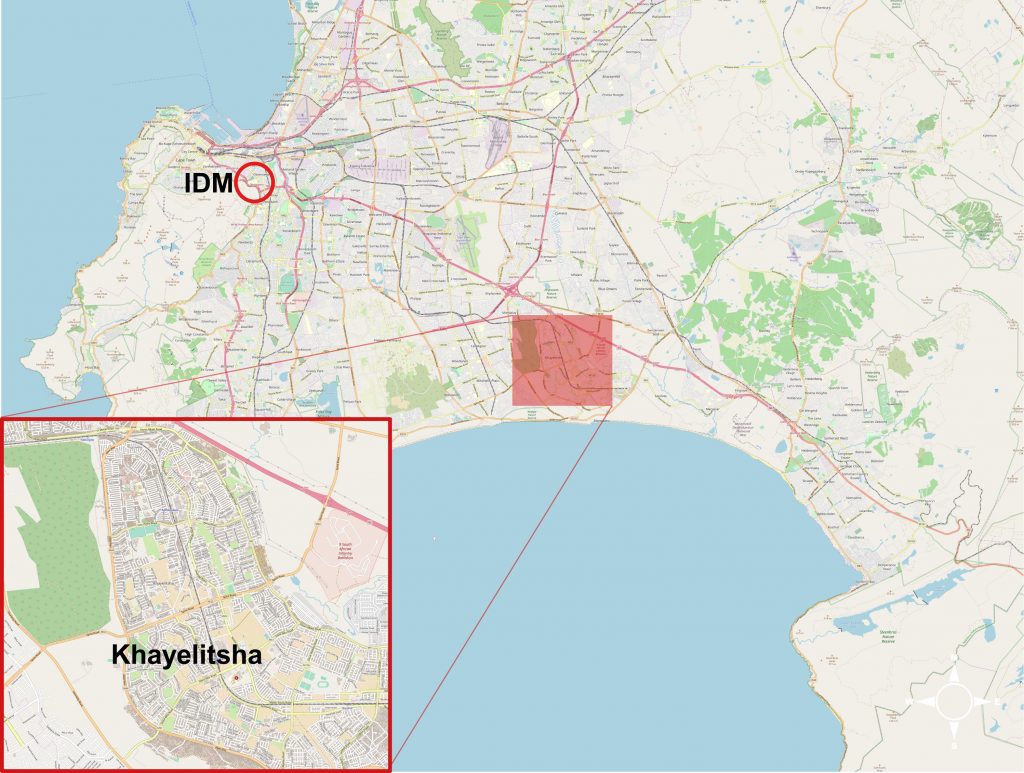
Greater Cape Town area, showing relative positions of the IDM and Khayelitsha
The burden of infectious disease in South Africa is extreme, and the people of Khayelitsha township suffer exceptionally high levels of unemployment and chronic ill-health. In 2015, the antenatal HIV prevalence in Khayelitsha was around 30%, and the TB case notification rate 917 per 100,000 people.
In contrast, in 2015 the HIV prevalence in the entire Western Cape province was estimated at 19%. The same year, the TB case notification rate in the Western Cape was 681 per 100,000 people.
Real world impact
CIDRI-Africa (and its predecessor, the Clinical Infectious Diseases Research Initiative) has contributed to translation of research into real-world impact. We have participated in:
- a trial of isoniazid preventive therapy in HIV-infected persons on ART;
- transcriptomic profiling studies to develop a biosignature of TB disease;
- research into the association between vitamin D deficiency and HIV-TB;
- definitive studies on HIV-TB immune reconstitution inflammatory syndrome;
- influential TB diagnostic studies (Gene Xpert and Fuji LAM); and
- a trial of the most promising TB vaccine (M72/AS01E) since the introduction of BCG.
A one-stop-shop for research
We want to address the persistent burden of infectious disease in South Africa through high quality, population-relevant research; in parallel, we feel that our results should be freely available to researchers and accessible by the community in which we work.
We want to use the most widely accessible avenues to communicate our research results: our Gateway on Wellcome Open Research provides a one-stop-shop for anyone to read and engage with our findings.