Wellcome Open Research: a summary of year 2
| 21 January, 2019 | Abbie nicholson |

Robert Kiley, Head of Open Research, Wellcome and Michael Markie, Publishing Director, F1000 highlight Wellcome Open Research’s achievements after two years of publishing.
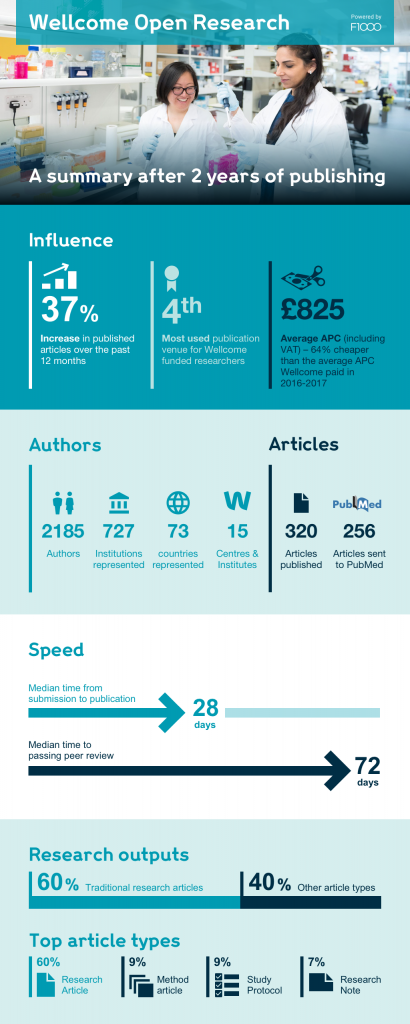
The Wellcome Open Research publishing platform has been fully operational for two years and in this time has grown to become one of the most used venues for Wellcome-funded researchers to share their research findings.
In this blog we review 2018 – the second full year of operating this platform – and look forward to some of the changes which we will be introducing in 2019.
Year 2 in numbers
2018 witnessed a significant growth in the total number of articles of published on this platform, with a 37% increase in the number of articles published, compared with 2017.
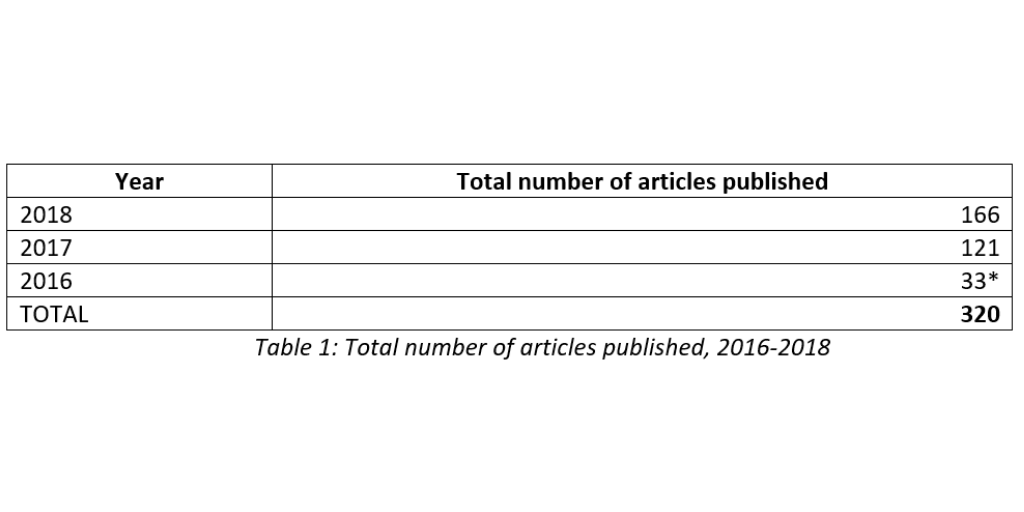
* (Note: articles were accepted from June 2016; site went live 14th November 2016)
As a consequence of this growth, Wellcome Open Research was the fourth most used publishing venue for Wellcome-funded researchers in 2018 (Table 2), publishing 166 articles. As Wellcome Open Research uses a post publication peer review model, not all these articles (as of 4th January 2019) have passed peer reviewed, hence why not all of them are currently indexed in PubMed.
| # | Journal | Total number of Wellcome attributed papers published in 2018 |
| 1 | Scientific Reports | 248 |
| 2 | Nature Communications | 238 |
| 3 | Plos One | 212 |
| 4 | Wellcome Open Research | 166 (of which 106 are indexed in PubMed) |
| 5 | eLife | 101 |
| 6 | PNAS | 97 |
| 7 | Frontiers in Immunology | 83 |
| 8 | Cell Reports | 73 |
| 9 | BMJ Open | 67 |
| 10 | Nucleic Acids Research | 64 |
Top 10 journals (by volume) used by Wellcome-funded researchers
Looking across the entire dataset, we have published articles from 2185 unique authors (309 authors have published more than once), based in 727 institutions, from 73 different countries.
In addition to publishing research articles, the platform also enables researchers to share other findings – such as data notes, study protocols and null or negative findings. Of the 166 articles published in 2017, some 73 (44%) were non-traditional research articles, which researchers may have had difficulties in getting published elsewhere.
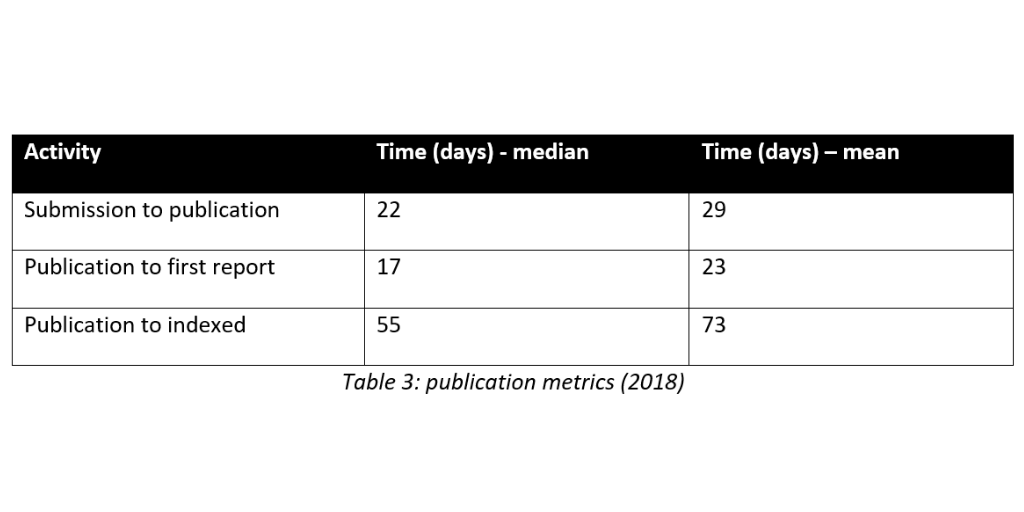
One of the platform’s unique selling points is the speed in which articles are published and peer reviewed. Table 3, below, shows that most articles are published within 22 days of being submitted and receive the first peer review report some 17 days later. Once an article has received two “approved” statuses from reviewers (or one “approved” and two “approved with reservation” statuses) articles are submitted for indexing in PubMed and other bibliographic databases. The median, end-to-end elapsed time, from submission to when article has passed peer review, is 72 days.
Articles on the platform are also well read and cited. To date, some 32% of all articles have at least one citation, whilst the most cited article (a software tool article) has received 13 citations (according to Europe PMC) and 22 citations (according to Dimensions).
In addition to publishing articles, we also publish every peer review report – and have over 900 on the site – along with the name of the reviewer and their ORCID iD (when connected by the reviewer).
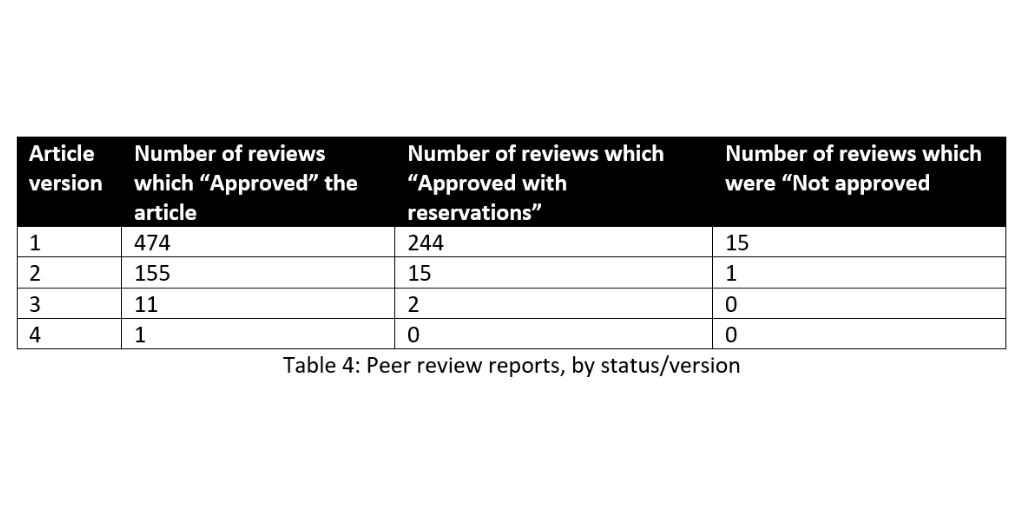
As well as providing feedback to the researcher on how an article could be improved – remember, reviewers are not having to decide whether the article should be published; that has already happened – reviewers assign a status report to their review (see Table 4). In response to peer feedback, researchers can update their articles and publish a new version. It’s common to see reviewers suggest improvements and communicate directly with authors to advance the work that has been published.
Another major benefit of this model of publication is that the costs are much lower than other publishing venues – you can find more details about article processing charges on Wellcome Open Research here.
2018 has also been a year in which we have focused on building new services for our authors and their institutions. Specifically, we have created several gateways (eight to-date) which bring together all the articles published on the platform from a specific institution or grant programme and provide an opportunity to highlight items of interest and events. We have also launched our first “collection” – the financialisation of global health – which again provides a means of linking related articles together.
We also published data on the gender diversity of authors and reviewers. This provided a positive outlook in terms of author submissions, with an almost 50/50 gender split (51% male and 47% female). This balance however, was not replicated when we looked at our reviewers, which showed that female reviewers were outnumbered by their male counterparts by more than 2 to 1.
The year ahead
Addressing the gender balance of our reviewers will be one of the areas we seek to address in 2019, encouraging authors (who are the main source of identifying reviewers) to think about suggesting a more diverse pool of reviewers.
We also plan to redesign the article page – to make it easier to access the data underlying the research article, and to make the open peer review reports more prominent on the page. The screen shot below shows an early prototype of what the article page may look like.
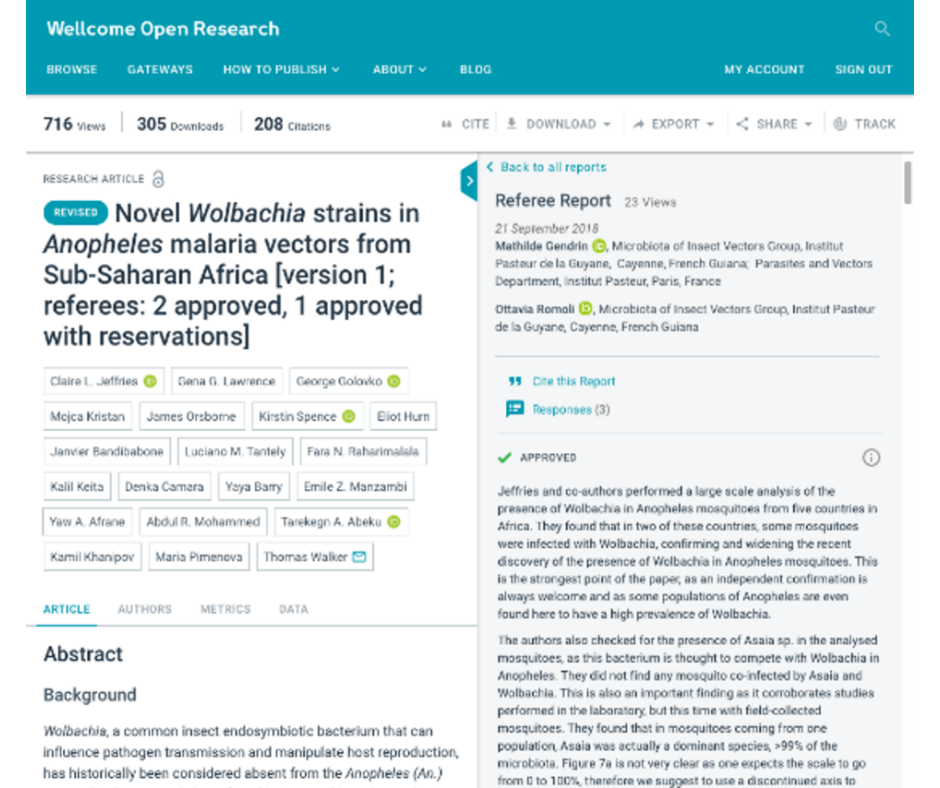
We will also be launching an Early Career Researcher Advisory Board – modelled on the work eLife have done – to steer the continuing development of the Wellcome Open Research publishing platform such that it becomes the “go to” publishing venue for our researchers.
We will continue to promote the platform and, in response to feedback, consider changing or modifying any process which our researchers think could be improved.
Finally, with Wellcome’s new Open Access policy coming into effect on 1st January 2020, we will work to ensure our researchers are aware of these changes and that the Wellcome Open Research platform is fully compliant with this new policy.