The art of good microscopy
By Guest Author
04 Apr 2018
Paul Dalgarno, an author on a Research Article published in Wellcome Open Research, talks about the potential and effectiveness for citizen science through a national imaging initiative in Scotland, the EnLightenment project.
The EnLightenment project set out to provide high quality, portable and easy to use microscopes to secondary school pupils throughout Scotland. We wanted to take the technology that underpins our research into cell function and healthcare and make it accessible to anyone.
Our goal was to enable thousands of teenagers the ability to image single cells in an everyday classroom environment. To achieve this, we needed a cost effective, yet easy to use and high performance microscope.
Just a couple of lenses
There are only a few key components to any microscope, whether a state of the art super resolution system or a simple toy for exploring bugs and dirt in the back garden. Strip any microscope down to its most basic form and it’s just two lenses, working to relay a magnified image onto some form of camera, detector or an eye.
The properties of the lenses dictate magnification, and the quality of lenses and camera image quality. This graceful, simple elegance is whats produced one of the most important technologies across the history of science. However, to produce a cost-effective microscope for everyday use is still challenging.
Good quality optics and camera must be paired with a display, all of which can be expensive and cumbersome. However, most of us carry these very things with us every day in our smartphones and tablets, so with our EnLightenment project we took advantage of that technology to achieve all of our goals, and more.

A great pairing
Pairing a smartphone camera with an external lens creates a simple microscope. The smartphone camera lens acts as the eyepiece, the external lens the objective, and the smartphone camera the detector. The beauty is the smartphone also comes with built in display, portability, connectivity, storage and image processing, and is inherently usable by the owner. It’s a fantastic combination, that makes smartphones one of the greatest tools for engaging people in science and technology.
This smartphone microscope concept was not new for EnLightenment, like any good science we took inspiration from many others. However, we set out to push the technology as far as it can go. Through rigorous testing we identified an objective lens that balanced usability with extremely high performance and low cost. A simple but effective Perspex and screw based housing brought it all together.
After excellent feedback on prototypes at local schools and science festivals we rolled EnLightenment out nationally, sending 500 microscopes to 100 Secondary schools throughout Scotland. The supporting website provided guidance and lesson plans to help pupils and teachers engage with the project.

Time to explore
However, we left things intentionally open. The idea was to allow pupils to explore what the microscopes could do, and we encouraged applications across all sciences and technology. We framed the project around an imaging competition.
Pupils could upload images direct from a smartphone to the website and an expert panel of scientists, artists and science communicators voted on their favourites. The EnLightenment team travelled to several schools to offer additional support, and a series of public lectures at science festivals throughout Scotland presented the project to a wider public audience. The project concluded with a prize giving at the closing ceremony of the International Year of Light, with schools travelling from all over the country to be part of it.

The legacy continues
EnLightenment was a huge success. We had over 500 images uploaded, with contributions from almost every school participating. Feedback was generally very positive from teachers, pupils and parents. Today the legacy of EnLightenment continues.
The smartphone microscopes are still used in the schools and have been used to study microscope sea life on the West Coast of Scotland, at numerous science festivals and even at scientific conferences to demonstrate key microscopy principals. The website and resources remain and the EnLightenment team continue to provide additional support to a wide variety of users.
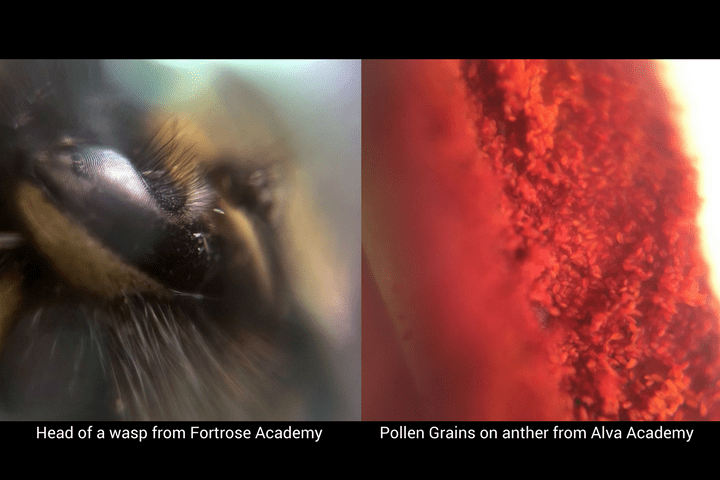
However, it is not these numbers, stats or events that I think of when I look back on the project. What amazed me, and what still amazes me today, is the phenomenal quality of image submissions from the pupils, many of which were comparable with the research grade microscopes that populate our optics and life science labs here at Heriot-Watt University.
There were wasp eyes, butterfly wings, crystals, pollen, coins and more. There where images of wonderful science, of huge detail, artistic beauty, colour and depth. This was much more than just microscope performance. There is an art to good microscopy, one that is revealed only through time, trial and error and commitment, and passion and excitement drives this. It was simply wonderful to see the pupils embrace and deliver in such a variety of ways.
To me that is the ultimate measure of success, and myself and the EnLightenment team are extremely proud, not of our own contribution to the project, but of the pupils, teachers and public that did the hard work, and delivered far beyond our original expectations.