Community drama to promote awareness of malaria prevention
| 13 March, 2018 | Renly Lim and Phaik Yeong Cheah |
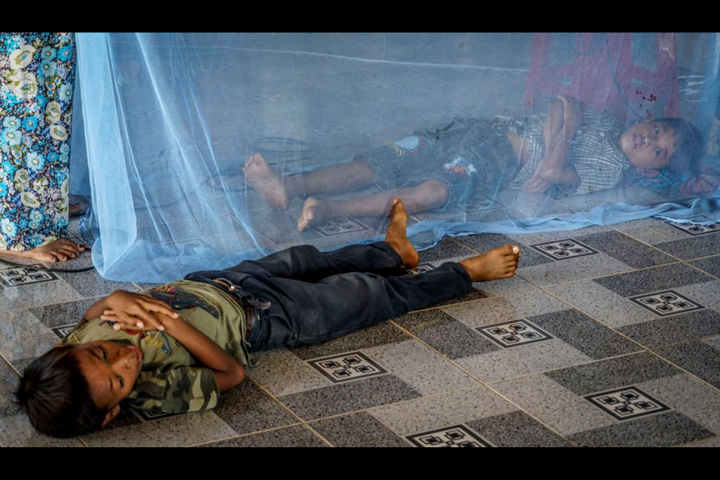
Children practising during the workshops for drama performance on the third evening (Photography by Nicky Almasy)
Renly Lim and Phaik Yeong Cheah discuss their Research Article on how drama can be used as a community engagement strategy to raise awareness about malaria.
The Village Drama Against Malaria (VDAM) project was a pilot science-arts initiative orchestrated by the Mahidol-Oxford Tropical Medicine Research Unit (MORU) in partnership with the Battambang Provincial Health Department and the National Center for Parasitology Entomology and Malaria Control, Cambodia (CNM).
In 2016, a series of drama and music workshops were conducted in 20 remote villages in the Battambang Province, Cambodia. These villages were selected because of their high malaria incidence. The villages are generally poor and most families are involved in small-scale agriculture. The villages typically have only basic infrastructure.
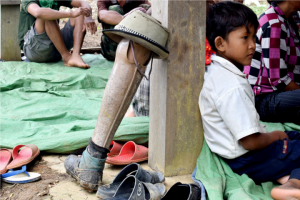
Locally, the presence of millions of hidden and unexploded land mines during the Khmer Rouge regime in the 1970s and in the civil war in the 1980s makes local journey difficult and many villagers have lost legs from landmine blasts.
Drama to promote awareness of malaria prevention
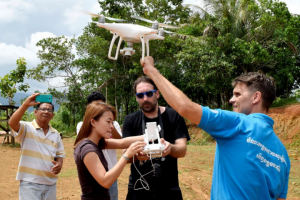
Cambodian (Khmer) drama, which uses comedy and music to tell stories with local references and language that resonates with villagers, are very popular in rural communities. Our project mixed art and drama with modern technologies, such as using drones to film the villages, and social media (Facebook and YouTube) to share photos and videos.
Putting the project together
We first introduced the project to, and sought approval, from the national and provincial health departments. The local team (village leaders, key opinion leaders, village malaria workers) played an active role throughout the project development and progress.
We scouted for professional drama performers in Battambang province. Every effort was made to ensure involvement of local communities at all stages of implementation because their involvement is the key to the success of the project.
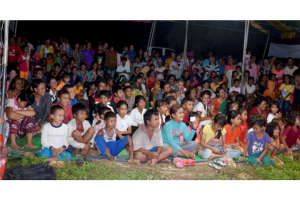
The project comprised a two and a half-day workshop and a performance on the third evening in each village. During the workshops, people contributed performance talents, knowledge and real local stories which were then integrated into the drama performance.
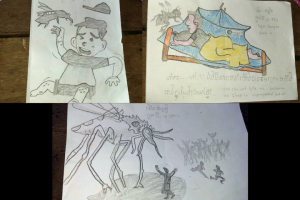
We recruited children from schools to sing songs about malaria and to create drawings with the malaria theme. We also actively involved teenagers and young people in the workshops and drama performances. The activities on the third evening included singing competitions, songs, and a quiz on malaria, culminating in a drama performance by both locals and professional drama team members.
The three key messages of the drama are to encourage people to prevent mosquito bites by using insecticide treated nets, to get early diagnosis and treatment from the village malaria workers, and to raise awareness about the risk of malaria in local forests.
Challenges faced
We faced several challenges throughout the course of the project planning and implementation. One of the major challenges faced was due to the rainy season. This caused significant disruption to travel plans meaning we could not proceed as scheduled and that a degree of flexibility had to be built into the plans.
We often needed to rearrange the performance schedule due to the degraded road conditions and bridges connecting villages which collapsed because of flood. Frequent heavy downpours also made it more difficult for villagers to participate in the drama workshops and performance.
Additionally, the project was under budgeted as we did not anticipate all the expenses required. The drama team rented a small truck to transport everything including team members, props, clothes, a canopy, the stage, food and more. This created extra work for the team and resilience was needed, especially considering there was often no proper place for the team to stay.
At the majority of locations, the drama members stayed under the pagoda, which is an open area, and slept under the mosquito nets. With twenty villages to perform in, we could only spend three days in each village before moving on to the next village.
Drama as part of community engagement
We published our evaluation of our project as a Research Article on Wellcome Open Research. The popularity of the performances and the positive findings of the qualitative and quantitative evaluation are encouraging. Villagers were eager to participate in the workshops and performances.
Audience members recalled the plot of the performance and the malaria-related messages, indicating that the key messages that we wanted to convey were clear and concrete. In 2017, we did a second drama project in 15 villages in Pailin Province, Cambodia. We share our experiences in another Research Article published in Global Bioethics.
We conclude that using drama is a promising way to engage communities and should be used as part of mobilising communities for malaria prevention and elimination. Subsequent drama projects could adopt a longer timeframe to allow more time in each village and to further enhance the overall experience. Involving local people including children from the beginning of the project and throughout the process is the ultimate key to success.
You can read more about Wellcome community engagement projects in our previous blog post.